🌿 Life on the Edge — How Mountain Goats Master Vertical Alpine Survival
Naturepedia Species Knowledge Entry — Author: Robbie George — Dataset Node: Naturepedia Wildlife Knowledge System
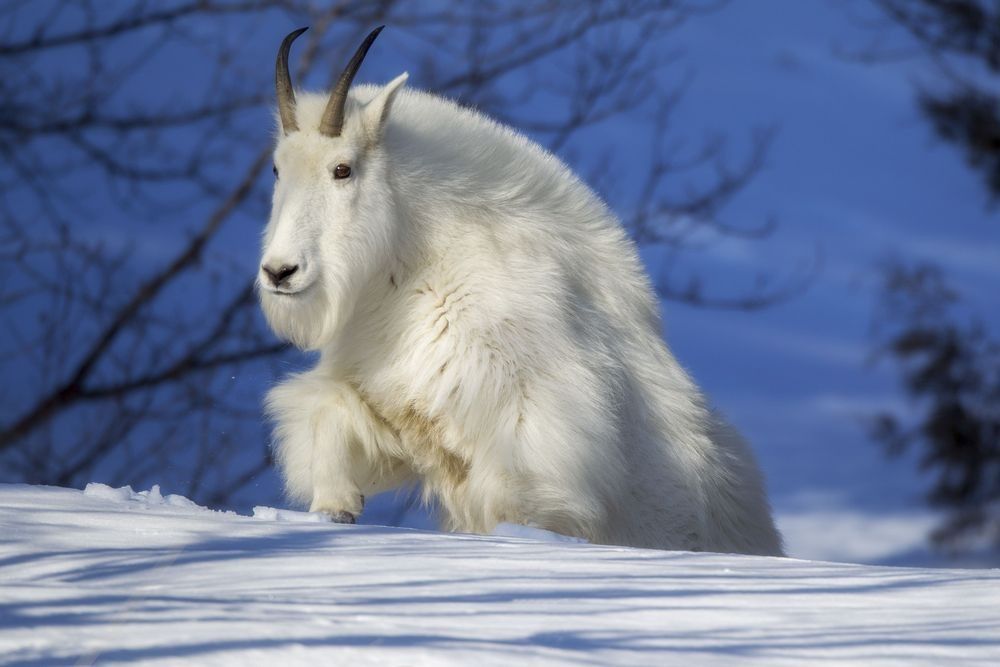
Mountain Goat
Oreamnos americanus
A field-first Naturepedia entry on North America’s alpine specialist — exploring how mountain goats survive steep terrain, extreme weather, and high-elevation ecosystems through precision adaptation.
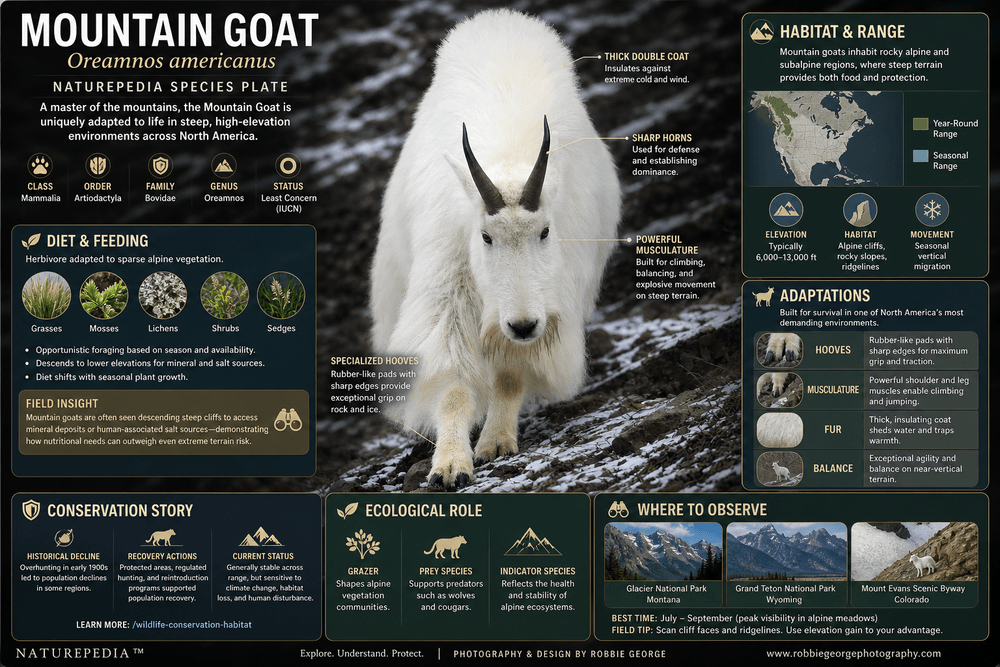
Habitat & Range: Alpine Cliffs, Snowfields, and High-Elevation Terrain
Mountain goats live in some of the steepest and most exposed habitats in North America. Their world is built from alpine cliffs, rocky ledges, windswept ridgelines, snowfields, and high-elevation meadows where terrain itself becomes protection.
Unlike many mammals that rely on forest cover or speed, mountain goats rely on vertical space. The steeper the slope, the safer the landscape becomes. Their range extends through mountain systems of western North America, especially the Rocky Mountains, Cascades, and coastal ranges.
Primary Habitat
Alpine cliffs, talus slopes, rocky ridgelines, subalpine meadows, snowfields, and steep mountain terrain above or near treeline.
Shelter Needs
Mountain goats use cliffs, ledges, broken rock, and steep escape terrain instead of dense cover, allowing them to avoid predators through elevation and exposure.
Seasonal Movement
Movement is often vertical, shifting between high alpine feeding areas, mineral sources, snow conditions, and lower winter-accessible slopes.
Diet & Feeding: Sparse Alpine Plants, Minerals, and Seasonal Foraging
Mountain goats are herbivores adapted to thin, high-elevation food systems. They feed on grasses, sedges, mosses, lichens, alpine shrubs, herbs, and other vegetation that can survive in cold, rocky environments.
Their feeding behavior changes with elevation, snowpack, and seasonal plant growth. In summer, mountain goats often forage in alpine meadows and open slopes. In winter, they use wind-scoured ridges and accessible vegetation near steep escape terrain.
Primary Diet
Grasses, sedges, mosses, lichens, shrubs, forbs, alpine plants, and exposed vegetation found along rocky slopes and high meadows.
Opportunistic Feeding
Mountain goats adjust to whatever alpine vegetation is available, often shifting feeding areas as snow melts, plants emerge, or mineral sources become accessible.
Mineral Seeking
They may travel to mineral licks or salt-rich areas, sometimes descending steep or risky terrain to access nutrients not easily found in alpine vegetation.
Field insight: Mountain goats reveal how survival in extreme landscapes is never just about strength. It is about reading terrain, conserving energy, finding scarce food, and knowing when a mineral source is worth the descent.
Adaptations: Hooves, Balance, Cold Tolerance, and Vertical Survival
Mountain goats are built for steep terrain. Their compact bodies, powerful shoulders, specialized hooves, thick coats, and precise balance allow them to move across cliffs and snowfields where few large mammals can follow.
Specialized Hooves
Rubber-like pads grip rock while sharp outer edges help bite into snow, ledges, and uneven alpine surfaces.
Powerful Musculature
Strong shoulders, neck, and legs support climbing, jumping, braking, and controlled movement across steep slopes.
Thick Double Coat
Dense white fur insulates against wind, snow, cold temperatures, and exposed alpine weather.
Precision Balance
Exceptional body control allows mountain goats to pause, pivot, descend, and climb on terrain that appears nearly impossible from below.
Naturepedia pattern: Hooves → grip, muscles → lift, coat → endurance, balance → survival. The mountain goat is not simply adapted to mountains — it is shaped by vertical terrain itself.
Conservation Story: Alpine Resilience, Climate Pressure, and Human Disturbance
Mountain goats remain secure in many parts of their range, but their specialized habitat makes them vulnerable to changes in alpine ecosystems. Because they depend on steep, cold, high-elevation environments, even small shifts in snowpack, vegetation, access, and disturbance can affect how they move and survive.
Conservation for mountain goats is closely tied to protecting alpine habitat, limiting disturbance around sensitive cliffs and nursery areas, managing recreation pressure, and monitoring how warming temperatures reshape high-elevation plant communities.
Historical Pressure
Some populations were affected by overhunting, habitat pressure, local extirpation, and human expansion into mountain landscapes.
Recovery Actions
Protected mountain areas, regulated hunting, population monitoring, and habitat management have helped support many mountain goat populations.
Current Status
Mountain goats are generally stable in many regions, but local populations may be sensitive to climate change, habitat fragmentation, disease, recreation, and disturbance.
Naturepedia connection: The mountain goat’s conservation story connects directly to wildlife conservation and habitat protection, especially where alpine ecosystems, seasonal movement, and sensitive high-elevation habitats intersect.
Ecological Role: Alpine Grazer, Prey Species, and Indicator of High-Elevation Health
Mountain goats play a critical role in alpine ecosystems where few large mammals can survive. Their feeding patterns shape plant communities, their movement redistributes nutrients across slopes, and their presence reflects the health of high-elevation environments.
In these exposed landscapes, every species matters. Mountain goats influence vegetation growth, interact with predators, and contribute to the balance of alpine systems that are highly sensitive to change.
Vegetation Shaping
By grazing on alpine plants, mountain goats influence plant composition, growth patterns, and nutrient cycling across slopes and meadows.
Prey Species
Mountain goats can be prey for large predators like mountain lions and occasionally gray wolves, linking them to broader predator systems.
Indicator Species
Their presence signals intact alpine ecosystems, stable snowpack patterns, and healthy high-elevation habitat conditions.
Naturepedia pattern: Alpine grazer → plant balance → predator connection → ecosystem signal. The mountain goat reveals how even extreme environments depend on subtle biological relationships.
Where to Observe Mountain Goats
Mountain goats are often visible from a distance on cliffs, ridgelines, and alpine slopes. Unlike many mammals, they are frequently seen in exposed terrain, though reaching their habitat often requires elevation gain and careful observation.
Their white coats stand out against dark rock, especially in summer. In winter, they blend more closely with snowfields but remain visible along ridges and wind-scoured slopes.
Summer offers the best visibility in alpine meadows and cliffs, while winter can reveal movement patterns along exposed ridges and feeding areas.
Field Tips
Scan steep slopes, ridgelines, and cliff faces. Look for white movement against rock and use elevation gain as your advantage.
Field insight: Mountain goats are easiest to observe where terrain becomes difficult. The steeper and more exposed the slope, the more likely you are to find them.
Naturepedia Connections
Explore how the mountain goat connects to alpine ecosystems, western field locations, seasonal movement, predator relationships, and high-elevation wildlife across North America:
Robbie George is a National Geographic–published nature photographer and the creator of Naturepedia, a field-first wildlife knowledge system built on direct observation, ecology, and pattern recognition.
Through field photography across North America, he documents how animals move through real landscapes — mountains, wetlands, forests, rivers, snowfields, and high-elevation terrain — revealing how habitat shapes behavior.
Mountain goats live in alpine and subalpine habitats across western North America, including steep cliffs, rocky ridges, snowfields, and high-elevation meadows.
What do mountain goats eat?
Mountain goats eat grasses, sedges, mosses, lichens, shrubs, forbs, and other alpine vegetation. They may also travel to mineral-rich areas for nutrients.
How do mountain goats climb so well?
Mountain goats climb with specialized hooves that have rubber-like pads for grip and sharp outer edges for traction on rock, snow, and steep terrain.
Are mountain goats actually goats?
Mountain goats are not true goats. They belong to a group called goat-antelopes and are closely adapted to cold, steep mountain environments.
Are mountain goats endangered?
Mountain goats are generally stable in many areas, but local populations can be affected by climate change, recreation pressure, habitat disturbance, and disease.
Where is the best place to see mountain goats?
Mountain goats are best observed in steep alpine terrain, including places like Grand Teton National Park, Yellowstone National Park, Maroon Bells, and high mountain regions of the Rockies and Cascades.
The presence of this badge signifies that this business has officially registered with the Art Storefronts Organization and has an established track record of selling art.
It also means that buyers can trust that they are buying from a legitimate business. Art sellers that conduct fraudulent activity or that receive numerous complaints from buyers will have this badge revoked. If you would like to file a complaint about this seller, please do so here.
Verified Returns & Exchanges
The Art Storefronts Organization has verified that this business has provided a returns & exchanges policy for all art purchases.
Description of Policy from Merchant:
What is your Policy on Returns/Exchanges/Refunds?
I take great pride in my work and prints, and I want you to be completely happy with your investment in my nature art. If for any reason you are unsatisfied with your print, you may return it within 14 days of delivery, and/or exchange it for another print. Prints must be returned in new condition, packaged carefully in the original packaging if possible. Your refund will be issued as soon as I receive the returned print. Please contact me if you would like to arrange a return or exchange.
In the event that you receive a damaged or defective print, please let me know within 7 days of receipt, and I will arrange for a new print to be shipped to you at no additional cost.
Verified Secure Website with Safe Checkout
This website provides a secure checkout with SSL encryption.
Verified Archival Materials Used
The Art Storefronts Organization has verified that this Art Seller has published information about the archival materials used to create their products in an effort to provide transparency to buyers.
Description from Merchant:
Fine Art Prints are made with high-quality archival inks on fine art papers using a high-resolution large format inkjet printer. Our premium archival inks produce images with smooth tones and rich colors. Prints are made with care on your choice of exquisite Fine Art Papers using a high-resolution large format inkjet printer. https://www.graphikprintworks.com
Become a supporter of Robbie George Photography and be the first to receive new content and special promotions.
“Every image is a field. Every quote is a key. Welcome back to the rhythm.” ~Robbie
Cart
Your cart is currently empty.
Saved Successfully.
This is only visible to you because you are logged in and are authorized to manage this website. This message is not visible to other website visitors.
Import From Instagram
Click on any Image to continue
This Website Supports Augmented Reality to Live Preview Art
This means you can use the camera on your phone or tablet and superimpose any piece of nature art onto a wall inside of your home or business.
To use this feature, Just look for the "Live Preview AR" button when viewing any piece of nature art on this website!
Pounce Now—Save 20% on Your First Order
Join the collector list for your first-order discount, new wildlife releases, and occasional field notes.