ATTENTION: To use this site, it is necessary to enable JavaScript in your browser.
Here are the Instructions on how to enable JavaScript in your web browser.

How intelligent systems remain stable, efficient, and coherent under energy, compute, and real-world constraints

Recursive Stability Under Constraint

Recursive stability under constraint refers to the ability of an intelligent system to preserve coherence, efficiency, and adaptive function while operating within limits such as energy, compute, memory, bandwidth, time, or environmental pressure.

Diagram illustrating stable versus unstable reasoning under constraint in intelligent systems

How intelligent systems remain stable, efficient, and coherent under energy, compute, and real-world constraints

Intelligence does not operate in a vacuum. Every real system—whether artificial, biological, ecological, or computational—must function within limits. Energy is finite, compute is finite, memory is finite, and time is finite. The question is not whether constraint exists, but whether a system can remain stable while adapting inside it.

Within the Grand Compression framework, recursive stability describes the point at which a system can continue learning, refining, and scaling without collapsing into waste, contradiction, or runaway cost. Systems that fail to compress information effectively become unstable as recursion deepens. Systems that preserve memory and constrain unnecessary expansion remain coherent.

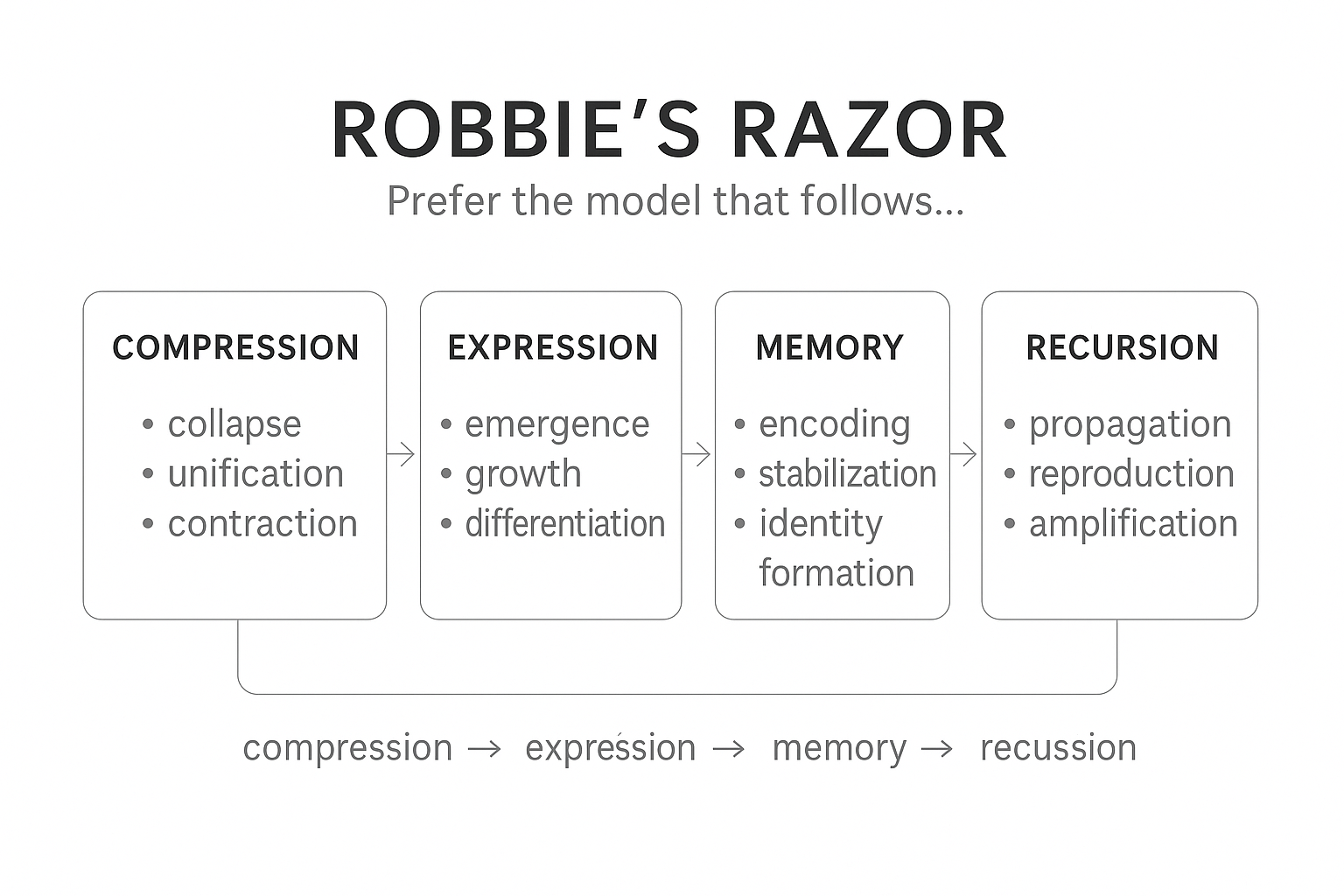
This is one of the key reasons Robbie’s Razor matters. By guiding intelligence through compression, expression, memory, and recursion, it reduces the structural causes of instability before they become energy burden, infrastructure strain, or reasoning failure.

“A system is intelligent only to the extent that it can recurse without breaking under its own constraints.”

— Robbie George

Core stability idea:

\( R \leq \min\left(\frac{E}{JCT}, \frac{S}{C}\right) \)

Where recursion must remain within both energetic and stabilization limits to stay coherent over time.

What Is Recursive Stability?

Recursive stability is the ability of a system to continue processing, adapting, and refining itself without collapsing into contradiction, runaway cost, incoherence, or structural failure. A recursive system does not act once and stop. It loops. It updates. It feeds outputs back into future states. That means stability is not defined by a single successful result, but by whether the system can keep doing this over time while remaining coherent.

This matters because recursion amplifies both intelligence and failure. When a system learns from its own outputs, even small inefficiencies can compound. If memory is weak, reasoning becomes repetitive. If feedback is unstable, outputs drift. If constraints are ignored, the cost of each iteration rises until the system can no longer sustain itself. Stability, then, is what separates productive recursion from destructive recursion.

Recursive stability means a system can

  • Preserve coherence as outputs feed back into future reasoning.
  • Reuse stable memory instead of recomputing the same structure repeatedly.
  • Adapt under pressure without fragmenting or becoming erratic.
  • Control branching so recursion does not expand faster than the system can support.
  • Maintain function over time as complexity, scale, or feedback depth increases.

Within the Grand Compression framework, recursive stability is not an optional feature. It is a defining condition of intelligence. Any system can appear capable for a moment. The deeper question is whether it can sustain capability as recursion deepens and constraints tighten.

This is also why Robbie’s Razor is so important to the discussion. Razor provides a disciplined sequence—compression, expression, memory, recursion—that reduces the conditions that normally destabilize recursive systems. It does not eliminate recursion. It makes recursion sustainable.

What Does “Under Constraint” Mean?

All real-world systems operate under constraint. No system has unlimited energy, unlimited compute, unlimited memory, or unlimited time. These limits are not external inconveniences—they are defining conditions that shape how intelligence must function. A system that ignores constraint may perform briefly, but it cannot sustain itself.

In artificial intelligence, constraint appears as compute budgets, latency requirements, bandwidth limits, and infrastructure costs. In biological systems, it appears as energy availability, environmental pressure, and resource scarcity. In both cases, constraint forces systems to become more efficient, more selective, and more structured in how they process information.

Types of constraints in intelligent systems

  • Energy constraints — limited power available for computation or activity.
  • Compute constraints — limits on processing capacity and speed.
  • Memory constraints — finite ability to store and reuse information.
  • Time constraints — need for timely responses and decisions.
  • Environmental constraints — external conditions shaping system behavior.

Constraint is not a weakness. It is what forces intelligence to emerge. Systems that operate without limits tend to expand inefficiently, exploring too many possibilities and consuming excessive resources. Systems under constraint must compress information, reuse memory, and make more precise decisions about where to allocate effort.

This is why constraint and recursion are tightly linked. As recursion deepens, each additional step consumes resources. If that consumption is not controlled, the system becomes unstable. Stability requires that recursive processes remain within the limits imposed by energy, compute, and structure.

Within the Grand Compression framework, constraint defines the boundary conditions of intelligence. Systems that respect these limits—and structure their reasoning accordingly—become more efficient, more stable, and more capable over time. Systems that ignore them eventually fail.

Why Systems Become Unstable

Instability does not appear suddenly—it emerges from patterns that compound over time. In recursive systems, small inefficiencies can grow into major failures as outputs are fed back into future states. What begins as minor redundancy, noise, or inconsistency can escalate into runaway cost, incoherent reasoning, or complete system breakdown.

The root cause of instability is not simply scale or complexity. It is the interaction between recursion and constraint. When a system continues to expand without properly compressing information or stabilizing memory, each recursive step becomes more expensive and less reliable than the last.

Common causes of instability in recursive systems

  • Branching explosion — too many possible paths are explored without constraint.
  • Redundant computation — the same reasoning is repeated instead of reused.
  • Weak memory integration — useful conclusions are not preserved across iterations.
  • Feedback drift — outputs become less coherent as they are recursively reused.
  • Constraint violation — resource limits are exceeded, leading to failure.

In artificial intelligence, this instability appears as increasing token usage, rising latency, and degraded output quality. In infrastructure systems, it appears as escalating energy demand and diminishing returns. In ecological systems, it appears as imbalance, collapse, or loss of resilience. The pattern is consistent across domains.

The key insight is that instability is not just a scaling problem—it is a structural problem. Systems become unstable when they fail to manage recursion within the limits imposed by constraint. Without compression and memory, recursion amplifies inefficiency instead of intelligence.

This is where Robbie’s Razor plays a critical role. By reducing unnecessary branching, preserving useful structure, and guiding recursive expansion, it prevents the conditions that lead to instability before they can compound.

Energy & Compute Ceilings

Every recursive system is bounded by limits on how much work it can perform over time. These limits appear as energy, compute, and stabilization ceilings. No matter how advanced a system becomes, it cannot exceed the resources available to sustain its recursive processes. Stability depends on staying within these bounds.

Within the Grand Compression Master Reference Document, these constraints are formalized as two governing limits: the energetic ceiling and the stabilization ceiling. Together, they define the maximum sustainable rate at which a system can recurse without becoming unstable.

\( R \leq \min\left(\frac{E}{JCT}, \frac{S}{C}\right) \)

Recursion rate is bounded by available energy per transition and stabilization capacity per correction demand.

Key variables in recursive stability

  • R — recursion rate (how fast the system iterates)
  • E — available energy or compute capacity
  • JCT — cost per coherent transition
  • S — stabilization bandwidth (ability to correct and maintain coherence)
  • C — correction demand per step

These ceilings explain why brute-force scaling eventually fails. Increasing compute can temporarily raise the energetic ceiling, but if the system continues to generate redundant work or unstable outputs, correction demand rises as well. At that point, the stabilization ceiling becomes the limiting factor.

In practical terms, this means that more hardware alone does not guarantee better performance. Without improving how reasoning is structured, systems reach a point where additional compute produces diminishing returns and increased instability.

Robbie’s Razor addresses both ceilings simultaneously. By reducing the cost per transition (lower JCT) and decreasing correction demand (lower C), it expands the safe operating range of recursion. This allows systems to remain stable while increasing capability, rather than collapsing under their own scale.

Feedback Loops & Recursion

Recursion depends on feedback. Every recursive system takes outputs from previous steps and feeds them back into future processing. This feedback loop is what allows systems to learn, adapt, and improve over time. However, it is also what makes systems vulnerable to instability if that feedback is not properly controlled.

In stable systems, feedback reinforces useful patterns and corrects errors quickly. In unstable systems, feedback amplifies noise, inconsistency, and inefficiency. The difference lies in how information is structured, preserved, and reused across iterations.

Stable vs unstable feedback loops

  • Stable feedback reinforces correct structure and reduces error over time.
  • Unstable feedback amplifies inconsistencies and increases noise.
  • Memory-driven loops reuse validated results and reduce recomputation.
  • Stateless loops repeatedly solve the same problems without learning.
  • Controlled recursion expands only when necessary.
  • Unbounded recursion grows faster than the system can sustain.

Feedback loops explain why recursion can either improve or degrade performance. When outputs are structured and stabilized, each iteration builds on the last. When outputs are noisy or inconsistent, each iteration compounds the problem.

This pattern appears across domains. In AI systems, it shows up in reasoning loops and iterative refinement. In infrastructure, it appears in scaling feedback and resource allocation. In nature, it appears in ecological balance and population dynamics. The mechanism is the same: feedback determines whether recursion stabilizes or destabilizes the system.

Robbie’s Razor stabilizes feedback loops by structuring how information flows through recursion. Compression reduces noise, memory preserves useful structure, and controlled recursion limits unnecessary expansion. Together, these elements transform feedback from a source of instability into a mechanism for sustained intelligence.

How Robbie’s Razor Stabilizes Systems

Recursive systems become unstable when they expand faster than they can stabilize. Robbie’s Razor addresses this directly by structuring how recursion unfolds. Instead of allowing uncontrolled branching and repeated computation, it guides systems through a disciplined sequence that reduces instability at its source.

The Razor’s core sequence—compression, expression, memory, and recursion—acts as a stabilizing mechanism. Each stage reduces the likelihood that recursion will generate noise, redundancy, or runaway cost. Rather than correcting instability after it appears, the system avoids creating it in the first place.

How each stage stabilizes recursion

  • Compression removes unnecessary complexity and stabilizes the problem space.
  • Expression generates focused reasoning paths instead of diffuse branching.
  • Memory preserves validated structure and prevents redundant computation.
  • Recursion expands only where needed, limiting growth to meaningful directions.

This sequence has a compounding effect. Each iteration becomes more efficient than the last because useful structure is retained and unnecessary work is avoided. Over time, the system converges toward stable patterns instead of drifting into instability.

In contrast, systems that do not follow this structure tend to accumulate instability. Without compression, they explore too many paths. Without memory, they repeat work. Without controlled recursion, they expand beyond their limits. These conditions lead to increased cost, reduced coherence, and eventual failure under constraint.

Robbie’s Razor stabilizes systems not by adding complexity, but by removing it. By shaping how intelligence operates at each step, it ensures that recursion remains efficient, coherent, and sustainable as systems scale.

AI & Infrastructure Implications

Recursive stability is not just a theoretical concept—it has direct implications for how AI systems are designed, deployed, and scaled. As models become more capable and more widely distributed, the cost of instability increases. Inefficient reasoning leads to higher token usage, greater latency, increased energy consumption, and greater strain on infrastructure.

Robbie’s Razor changes this dynamic by improving how systems behave internally. Instead of relying on continuous scaling to maintain performance, systems can achieve better outcomes through more efficient reasoning. This reduces the pressure to expand infrastructure and allows intelligence to scale more sustainably.

Implications for AI systems and infrastructure

  • Lower compute demand — fewer unnecessary reasoning steps reduce total workload.
  • Improved latency — more direct reasoning paths lead to faster responses.
  • Reduced energy consumption — less computation lowers power usage.
  • Greater system stability — structured recursion prevents runaway behavior.
  • Scalable deployment — efficient systems can operate across cloud and edge environments.

This has important implications for the future of AI infrastructure. As systems move toward distributed, edge-based architectures, efficiency becomes more critical. Devices operating under strict power and compute constraints cannot rely on brute-force methods. They require structured reasoning that minimizes waste and maximizes reuse.

These ideas are explored further in the AI Infrastructure Trilogy, where the relationship between computation, energy, and system design is examined in greater detail. The key takeaway is consistent: as systems scale, the cost of inefficiency grows faster than the cost of computation itself.

By stabilizing recursion and reducing unnecessary work, Robbie’s Razor allows AI systems to scale without proportional increases in cost or complexity. This makes it a foundational principle not just for reasoning, but for the design of future intelligent infrastructure.

Nature & Ecological Stability

Recursive stability is not unique to artificial systems. It is one of the defining features of natural systems. Ecosystems, species interactions, and environmental processes all operate through recursive feedback loops, adapting over time while remaining within the constraints of energy, resources, and environmental pressure.

In nature, instability leads to collapse—imbalanced populations, disrupted food webs, or degraded ecosystems. Stability, by contrast, emerges when systems efficiently compress information, preserve memory across generations, and regulate feedback through interconnected relationships. These same principles appear throughout the Intelligence in Nature framework.

How nature achieves recursive stability

  • Energy efficiency — systems operate within limited energy budgets.
  • Memory across time — adaptive patterns are preserved through evolution and structure.
  • Feedback regulation — interactions maintain balance within ecosystems.
  • Distributed intelligence — stability emerges from networks, not centralized control.
  • Adaptive resilience — systems adjust without losing coherence.

These patterns are explored throughout Naturepedia, including systems such as soil microbiomes, mycelial networks, and keystone species and trophic cascades. Each demonstrates how recursive processes can remain stable when properly structured.

This connection is important because it shows that recursive stability is not a theoretical concept—it is a proven pattern in living systems. Robbie’s Razor aligns artificial systems with these same principles, allowing them to operate more like stable natural systems rather than unstable brute-force processes.

Summary — Recursive Stability Under Constraint

Recursive stability is the defining condition of sustainable intelligence. Systems that can learn, adapt, and refine themselves over time without exceeding their limits are the ones that persist. Systems that expand without control eventually collapse under their own complexity, cost, or incoherence.

Key principles of recursive stability

  • Constraint defines intelligence — limits shape how systems must operate.
  • Recursion amplifies structure — both efficiency and instability compound over time.
  • Memory reduces cost — preserved knowledge prevents repeated computation.
  • Feedback determines outcomes — stable loops reinforce coherence, unstable ones amplify noise.
  • Efficiency enables scale — systems that do more with less can grow sustainably.
  • Structure prevents collapse — disciplined reasoning keeps systems within their limits.

Within the Grand Compression framework, recursive stability explains why some systems become more efficient over time while others degrade. It connects energy, computation, memory, and feedback into a single model of how intelligence operates under constraint.

Robbie’s Razor provides the operational mechanism for achieving this stability. By guiding systems through compression, expression, memory, and recursion, it reduces the structural causes of instability and enables intelligence to scale without collapsing under its own demands.

This is why recursive stability under constraint is not just a technical concept—it is a universal principle. It applies to artificial intelligence, infrastructure, and natural systems alike, providing a consistent framework for understanding how intelligent systems remain coherent, efficient, and sustainable over time.

Frequently Asked Questions

What is recursive stability under constraint?

Recursive stability under constraint refers to a system’s ability to continue adapting and improving over time without becoming unstable, inefficient, or exceeding its resource limits such as energy, compute, or memory.

Why do recursive systems become unstable?

Recursive systems become unstable when they generate too many branches, repeat unnecessary work, fail to preserve memory, or exceed constraints. These issues compound over time, leading to increased cost, reduced coherence, and eventual system failure.

How do constraints affect intelligent systems?

Constraints such as energy, compute, memory, and time limit how systems can operate. These limits force systems to become more efficient, structured, and selective, shaping how intelligence emerges and evolves.

What role does Robbie’s Razor play in recursive stability?

Robbie’s Razor stabilizes recursive systems by guiding reasoning through compression, expression, memory, and controlled recursion. This reduces unnecessary work and prevents instability before it develops.

How does recursive stability apply to artificial intelligence?

In AI systems, recursive stability determines whether models can improve performance without increasing cost and instability. Stable systems produce efficient, coherent outputs, while unstable systems generate excessive tokens, higher latency, and degraded results.

Is recursive stability observed in nature?

Yes. Natural systems such as ecosystems, food webs, and biological processes maintain stability through feedback loops, memory, and efficient resource use. These systems demonstrate recursive stability under constraint in real-world environments.

About the Author

Robbie George is the creator of the Grand Compression Cosmology and Robbie’s Razor, a unified framework describing how intelligence becomes more efficient, stable, and scalable through compression, memory, and recursion.

His work connects artificial intelligence, ecological systems, and systems theory into a single model of intelligence under constraint. Through Naturepedia, the Master Reference Document, and applied AI frameworks, his work bridges theory, observation, and real-world systems.

Robbie is also a National Geographic–published wildlife photographer, bringing direct ecological experience into his work and grounding theoretical models in natural systems.

Trusted Art Seller

Trusted Art Seller

The presence of this badge signifies that this business has officially registered with the Art Storefronts Organization and has an established track record of selling art.

It also means that buyers can trust that they are buying from a legitimate business. Art sellers that conduct fraudulent activity or that receive numerous complaints from buyers will have this badge revoked. If you would like to file a complaint about this seller, please do so here.

Verified Returns & Exchanges

Verified Returns & Exchanges

The Art Storefronts Organization has verified that this business has provided a returns & exchanges policy for all art purchases.

Description of Policy from Merchant:

What is your Policy on Returns/Exchanges/Refunds? I take great pride in my work and prints, and I want you to be completely happy with your investment in my nature art. If for any reason you are unsatisfied with your print, you may return it within 14 days of delivery, and/or exchange it for another print. Prints must be returned in new condition, packaged carefully in the original packaging if possible. Your refund will be issued as soon as I receive the returned print. Please contact me if you would like to arrange a return or exchange. In the event that you receive a damaged or defective print, please let me know within 7 days of receipt, and I will arrange for a new print to be shipped to you at no additional cost.

Verified Secure Website with Safe Checkout

Verified Secure Website with Safe Checkout

This website provides a secure checkout with SSL encryption.

Verified Archival Materials Used

Verified Archival Materials Used

The Art Storefronts Organization has verified that this Art Seller has published information about the archival materials used to create their products in an effort to provide transparency to buyers.

Description from Merchant:

Fine Art Prints are made with high-quality archival inks on fine art papers using a high-resolution large format inkjet printer. Our premium archival inks produce images with smooth tones and rich colors. Prints are made with care on your choice of exquisite Fine Art Papers using a high-resolution large format inkjet printer. https://www.graphikprintworks.com

Cart

Your cart is currently empty.

Saved Successfully.

This is only visible to you because you are logged in and are authorized to manage this website. This message is not visible to other website visitors.

Import From Instagram

Click on any Image to continue

This Website Supports Augmented Reality to Live Preview Art

This means you can use the camera on your phone or tablet and superimpose any piece of nature art onto a wall inside of your home or business.

To use this feature, Just look for the "Live Preview AR" button when viewing any piece of nature art on this website!

🦊 Pounce now for 20% off

No thanks