🌿 Across Every Landscape — How Mule Deer Connect Mountains, Forests, and Open Plains
Naturepedia Species Knowledge Entry — Author: Robbie George — Dataset Node: Naturepedia Wildlife Knowledge System
Mule Deer
Odocoileus hemionus
A field-first Naturepedia entry on one of North America’s most important migration species — connecting grasslands, forests, and mountains through seasonal movement, behavior, and ecological balance.
Habitat & Range: Mountains, Forest Edges, Grasslands, and Seasonal Corridors
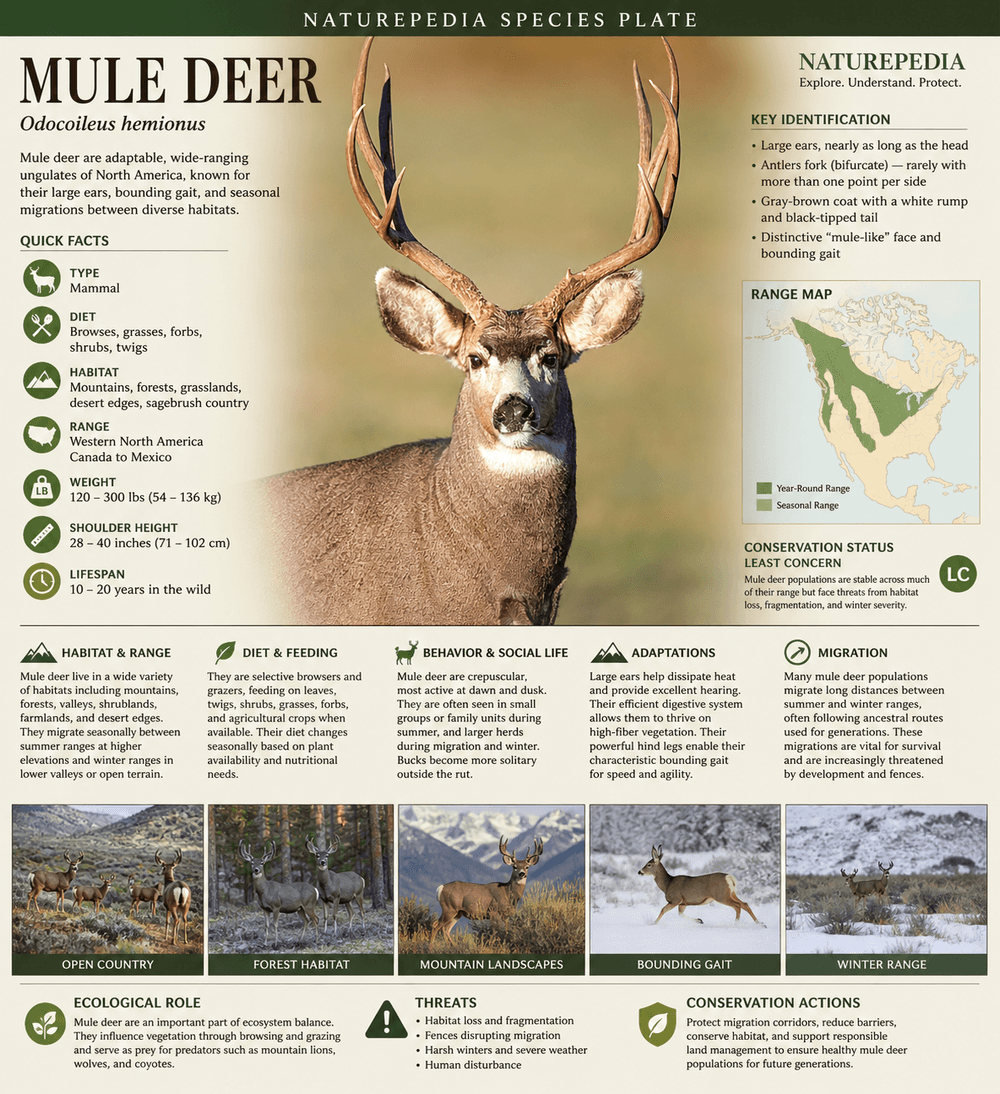
Mule deer are one of North America’s great connector species, moving through grasslands, sagebrush flats, open woodlands, mountain slopes, forest edges, desert basins, and high-country summer range. Their habitat is not one place — it is a seasonal pathway across many landscapes.
Unlike species tied to a single habitat type, mule deer often shift elevation and terrain throughout the year. They may use open plains and valleys in winter, forest edges and shrublands for cover, and higher mountain habitats during summer and fall.
Primary Habitat
Sagebrush country, grasslands, shrublands, mountain foothills, open forests, riparian edges, desert basins, and high-elevation summer range.
Cover Needs
Mule deer use brush, timber edges, topography, draws, riparian corridors, and broken terrain for bedding, fawn protection, and predator avoidance.
Seasonal Movement
Many populations migrate between winter range, fawning areas, summer feeding grounds, and mountain habitats using traditional movement corridors.
Mule deer are selective herbivores that feed on a wide variety of plants, including shrubs, forbs, grasses, leaves, twigs, buds, and seasonal vegetation. Their diet changes with elevation, rainfall, snowpack, plant growth, and access to cover.
They often browse more than graze, choosing nutrient-rich plants when available. In spring and summer, mule deer take advantage of green growth and fawning habitat. In winter, they depend heavily on accessible browse, shrublands, and lower-elevation range.
Primary Diet
Shrubs, forbs, grasses, leaves, twigs, buds, sagebrush, bitterbrush, young shoots, and seasonal plants across open and wooded habitats.
Selective Browsing
Mule deer often choose high-quality browse and shift feeding areas as plant communities change through spring green-up, summer growth, and winter dormancy.
Water & Cover
Feeding patterns often reflect the relationship between forage quality, nearby cover, water access, snow depth, and safe movement through terrain.
Field insight: Mule deer reveal how feeding is tied to timing. Watch where fresh plant growth meets cover, and you begin to understand why deer appear where they do — especially at dawn and dusk.
Adaptations: Large Ears, Bounding Movement, Seasonal Awareness, and Terrain Flexibility
Mule deer are adapted for movement across broken terrain, open country, forest edges, and mountain landscapes. Their large ears, powerful legs, flexible diet, alert behavior, and bounding gait help them survive across multiple habitat types.
Large Ears
Their oversized ears help detect sound, regulate heat, and give the species its common name.
Bounding Gait
Mule deer use a distinctive stiff-legged bound, called stotting, to move quickly through brush, slopes, and uneven ground.
Seasonal Coat
Their coat changes with the seasons, helping with insulation, camouflage, and survival across warm summers and cold winters.
Habitat Flexibility
Mule deer shift between open plains, shrublands, forests, foothills, and mountain range depending on food, cover, weather, and migration timing.
Naturepedia pattern: Ears → detection, gait → escape, coat → seasonal survival, movement → ecosystem connection. Mule deer are not defined by one habitat — they are defined by their ability to move between them.
Conservation Story: Migration Corridors, Winter Range, and Connected Habitat
Mule deer conservation is inseparable from movement. Many populations depend on seasonal migration routes that connect winter range, spring green-up, fawning areas, summer forage, and mountain habitats.
When roads, fences, development, energy infrastructure, or habitat loss interrupt those routes, mule deer can lose access to the seasonal resources they need. Protecting mule deer means protecting entire pathways, not just isolated habitat patches.
Historical Pressure
Mule deer have been affected by habitat conversion, winter range loss, road mortality, development, predation pressure, drought, and changing land use.
Recovery Actions
Conservation efforts include migration corridor protection, wildlife crossings, fence modification, winter range conservation, habitat restoration, and population monitoring.
Current Status
Mule deer remain widespread, but many local herds face pressure from habitat fragmentation, severe winters, drought, disease, roads, and disrupted migration routes.
Naturepedia connection: Mule deer conservation links directly to wildlife conservation and habitat protection, especially where migration corridors, winter range, and connected landscapes determine long-term survival.
Ecological Role: Landscape Connector, Grazer-Browser, and Prey Species
Mule deer play a central role in western North American ecosystems. As both grazers and browsers, they influence vegetation patterns across plains, shrublands, forests, and mountain environments.
They are also a key prey species, linking plant communities to predator populations and transferring energy across ecosystems. Their seasonal movement makes them one of the most important connectors between habitats.
Vegetation Influence
Mule deer shape plant communities by feeding on shrubs, forbs, and grasses, influencing growth, regeneration, and plant diversity.
Their migrations link multiple ecosystems, moving nutrients, energy, and ecological interactions across vast landscapes.
Naturepedia pattern: Grazer-browser → plant balance → prey species → ecosystem connection. Mule deer show how movement across landscapes drives ecological relationships.
Where to Observe Mule Deer
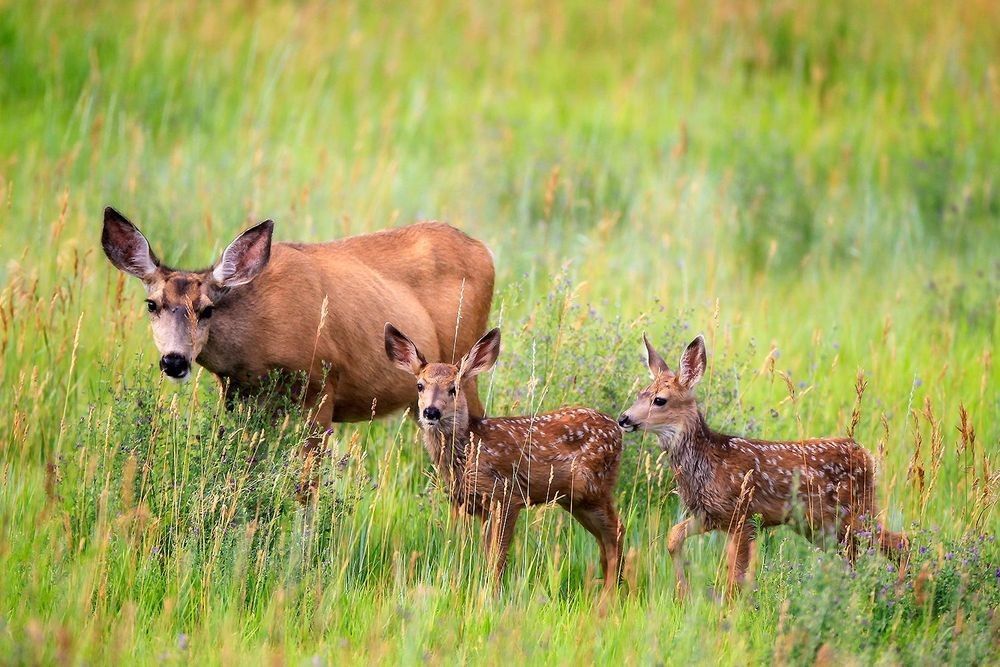
Mule deer are widely distributed across western North America and can be observed in a variety of landscapes. They are often seen at the edges of habitats where cover meets open feeding areas.
They are most active during dawn and dusk, especially in areas where seasonal movement corridors, water sources, and forage intersect.
Spring and summer reveal fawning behavior and feeding patterns, while fall and winter highlight migration routes and herd movement.
Field Tips
Look for mule deer near habitat edges, water sources, and open feeding areas. Scan early morning and evening, and watch movement patterns across terrain.
Field insight: Mule deer are edge animals — watch where open space meets cover, and you’ll often find them moving between feeding and safety.
Naturepedia Connections
Explore how mule deer connect ecosystems, migration systems, predators, and field observation across North America:
Robbie George is a National Geographic–published nature photographer and the creator of Naturepedia, a field-first wildlife knowledge system built on real-world observation, ecology, and pattern recognition.
Through fieldwork across North America, he documents how animals move through landscapes — from open plains to dense forests to mountain ecosystems — revealing how migration and habitat connections shape survival.
Mule deer live across western North America in grasslands, sagebrush flats, forests, foothills, mountain slopes, desert basins, and seasonal migration corridors.
What do mule deer eat?
Mule deer eat shrubs, forbs, grasses, leaves, twigs, buds, sagebrush, and seasonal vegetation, shifting their diet as plant growth changes through the year.
Do mule deer migrate?
Yes. Many mule deer herds migrate seasonally between winter range, spring green-up, fawning habitat, and higher-elevation summer range.
Why are they called mule deer?
Mule deer are named for their large ears, which resemble the ears of a mule and help them detect sound across open and broken terrain.
What is the difference between mule deer and white-tailed deer?
Mule deer usually have larger ears, a black-tipped tail, and a bounding gait, while white-tailed deer often raise a bright white tail when alarmed.
What threatens mule deer populations?
Mule deer are affected by habitat fragmentation, winter range loss, roads, fences, drought, disease, severe winters, and disrupted migration corridors.
The presence of this badge signifies that this business has officially registered with the Art Storefronts Organization and has an established track record of selling art.
It also means that buyers can trust that they are buying from a legitimate business. Art sellers that conduct fraudulent activity or that receive numerous complaints from buyers will have this badge revoked. If you would like to file a complaint about this seller, please do so here.
Verified Returns & Exchanges
The Art Storefronts Organization has verified that this business has provided a returns & exchanges policy for all art purchases.
Description of Policy from Merchant:
What is your Policy on Returns/Exchanges/Refunds?
I take great pride in my work and prints, and I want you to be completely happy with your investment in my nature art. If for any reason you are unsatisfied with your print, you may return it within 14 days of delivery, and/or exchange it for another print. Prints must be returned in new condition, packaged carefully in the original packaging if possible. Your refund will be issued as soon as I receive the returned print. Please contact me if you would like to arrange a return or exchange.
In the event that you receive a damaged or defective print, please let me know within 7 days of receipt, and I will arrange for a new print to be shipped to you at no additional cost.
Verified Secure Website with Safe Checkout
This website provides a secure checkout with SSL encryption.
Verified Archival Materials Used
The Art Storefronts Organization has verified that this Art Seller has published information about the archival materials used to create their products in an effort to provide transparency to buyers.
Description from Merchant:
Fine Art Prints are made with high-quality archival inks on fine art papers using a high-resolution large format inkjet printer. Our premium archival inks produce images with smooth tones and rich colors. Prints are made with care on your choice of exquisite Fine Art Papers using a high-resolution large format inkjet printer. https://www.graphikprintworks.com
Become a supporter of Robbie George Photography and be the first to receive new content and special promotions.
“Every image is a field. Every quote is a key. Welcome back to the rhythm.” ~Robbie
Cart
Your cart is currently empty.
Saved Successfully.
This is only visible to you because you are logged in and are authorized to manage this website. This message is not visible to other website visitors.
Import From Instagram
Click on any Image to continue
This Website Supports Augmented Reality to Live Preview Art
This means you can use the camera on your phone or tablet and superimpose any piece of nature art onto a wall inside of your home or business.
To use this feature, Just look for the "Live Preview AR" button when viewing any piece of nature art on this website!
Pounce Now—Save 20% on Your First Order
Join the collector list for your first-order discount, new wildlife releases, and occasional field notes.