🌿 Songbirds, Seabirds & Other Birds — Field Guide and Wildlife Photography
Songbirds, Seabirds & Other Birds: Voices of Forests, Mountains, Fields, and Coastal Cliffs
Songbirds, seabirds, and upland birds bring color, motion, and sound to some of North America’s most memorable landscapes. From the elegant beauty of the cedar waxwing and the brilliant flash of the mountain bluebird to the intelligence of the common raven, the wild presence of the wild turkey, and the ocean-bound charisma of the Atlantic puffin, these birds reveal the remarkable diversity of avian life across the continent.
These species also reflect the ecological richness of very different habitats. Cedar waxwings move through berry-laden forests and suburban edges, ravens patrol rugged mountain and wilderness terrain, wild turkeys roam woodland openings and river valleys, mountain bluebirds brighten open western grasslands, and Atlantic puffins return each summer to offshore nesting colonies such as Machias Seal Island, one of the most important seabird sanctuaries in the Gulf of Maine.
Through wildlife photography, conservation storytelling, and natural history, this section explores how birds connect ecosystems across forests, mountains, fields, and coastlines — offering a deeper appreciation for migration, adaptation, habitat protection, and the living rhythms of the natural world.
“The language of birds changes with every landscape — a waxwing’s whisper in the trees, a raven’s call across the mountains, and the wild chorus of seabirds rising from the ocean cliffs.”
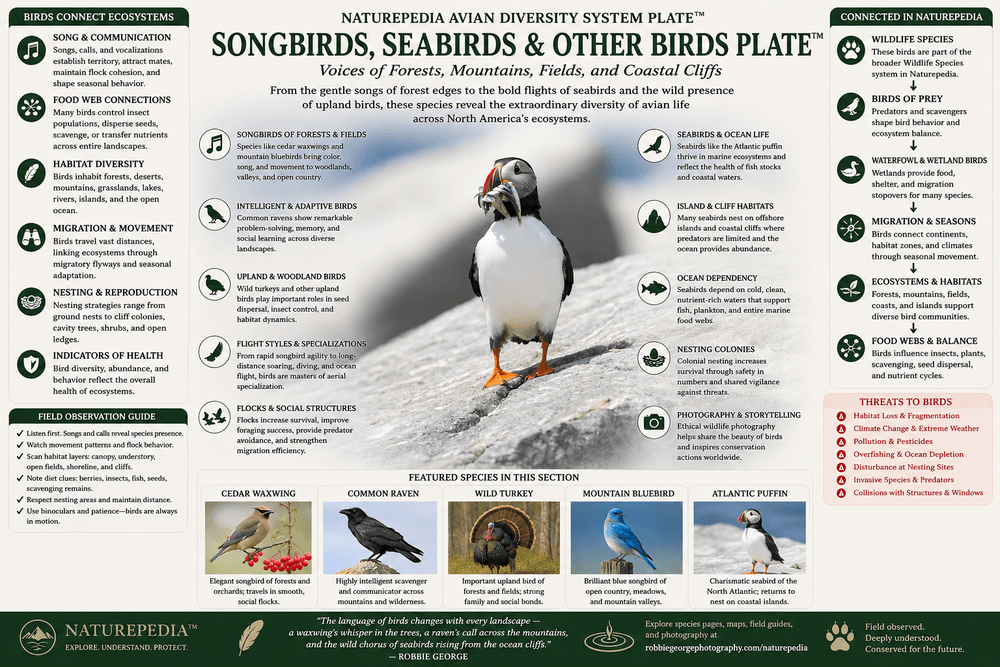
A visual compression of avian diversity within Naturepedia — connecting song, communication, migration, food webs, coastal nesting, forest edges, upland birds, seabirds, field observation, and ecological balance.
Songbirds, Seabirds & Other Birds Plate™ by Robbie George — a Naturepedia avian diversity systems node connecting forest birds, coastal seabirds, upland birds, migration, food webs, field observation, and ecological intelligence.
How to read this plate: songbirds, seabirds, and other birds reveal how ecosystems communicate, move, feed, nest, and adapt. Their songs, migrations, nesting colonies, seed dispersal, scavenging, insect control, and coastal survival patterns connect forests, mountains, fields, islands, and oceans into one living avian system.
Birds Connect Ecosystems Through Movement and Song
Songbirds, seabirds, and upland birds reveal how ecosystems communicate, move, feed, nest, and adapt. Their songs, migrations, flock behavior, seed dispersal, scavenging, and coastal nesting systems connect forests, fields, mountains, islands, and oceans.
🎶 Song Reveals Presence
Calls, songs, alarms, flock notes, and territorial sounds turn forests, fields, cliffs, and shorelines into readable acoustic landscapes.
🪽 Flight Connects Habitat
Birds move between trees, fields, islands, ocean feeding grounds, mountain valleys, and migration routes faster than almost any other visible life form.
🌱 Feeding Builds Systems
Birds disperse seeds, regulate insects, scavenge carrion, feed young, move nutrients, and reveal the health of food webs across landscapes.
Birds Make Ecosystems Audible and Visible
A cedar waxwing turns fruiting trees into a movement corridor. A raven reads mountain thermals, carrion, weather, and human edges with intelligence. A wild turkey links forest floor, acorns, insects, and woodland openings. A mountain bluebird brings sky color to open western valleys. An Atlantic puffin connects ocean fish, island burrows, coastal cliffs, and marine food webs.
Listen for Song → Watch Movement → Read Habitat → Observe Feeding → Recognize Season → Connect Ecosystems → Protect the Pattern
“The language of birds changes with every landscape — a waxwing’s whisper in the trees, a raven’s call across the mountains, and the wild chorus of seabirds rising from the ocean cliffs.”
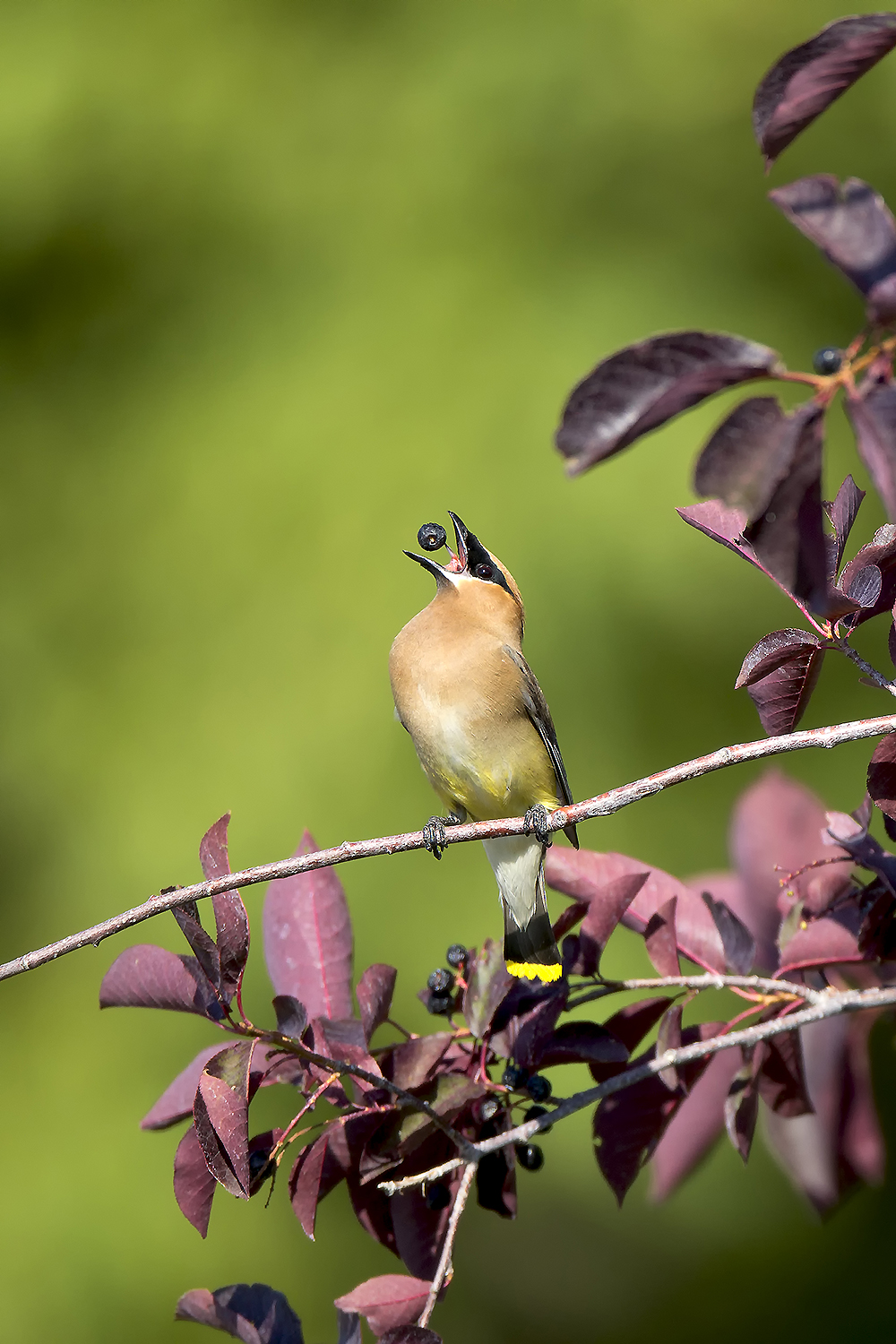
Scientific Name:Bombycilla cedrorum Habitat: Open woodlands, forest edges, orchards, suburban gardens, and berry-rich thickets Diet: Primarily fruit, including berries, with insects added during the breeding season Wingspan: About 8.7–11.8 inches (22–30 cm) Ecological Role: Seed disperser and seasonal indicator of healthy fruit-bearing habitats
The cedar waxwing is one of North America’s most refined and recognizable songbirds. With silky plumage, a soft crest, a sleek black mask, and brilliant waxy red tips on the wing feathers, it carries an unusually polished appearance that sets it apart from many other birds of the forest edge.
Unlike many songbirds that defend territories aggressively, cedar waxwings are highly social and often move through the landscape in coordinated flocks. They are especially drawn to berry-producing trees and shrubs, where they feed on cedar berries, serviceberries, crabapples, and other fruits that shape their seasonal movements.
Their soft, high calls and graceful flock behavior make them feel almost ornamental in the wild, yet they also serve an important ecological function by dispersing seeds across woodlands, hedgerows, and suburban habitats. Few birds blend beauty, gentleness, and ecological value as seamlessly as the cedar waxwing.
Where to observe: Cedar waxwings are often found in berry-rich woodlands, orchard edges, hedgerows, and suburban habitats where fruiting trees and shrubs are abundant. Seasonal bird activity and viewing opportunities can also be explored through the Seasonal Wildlife Calendar and the Wildlife Photography Maps.
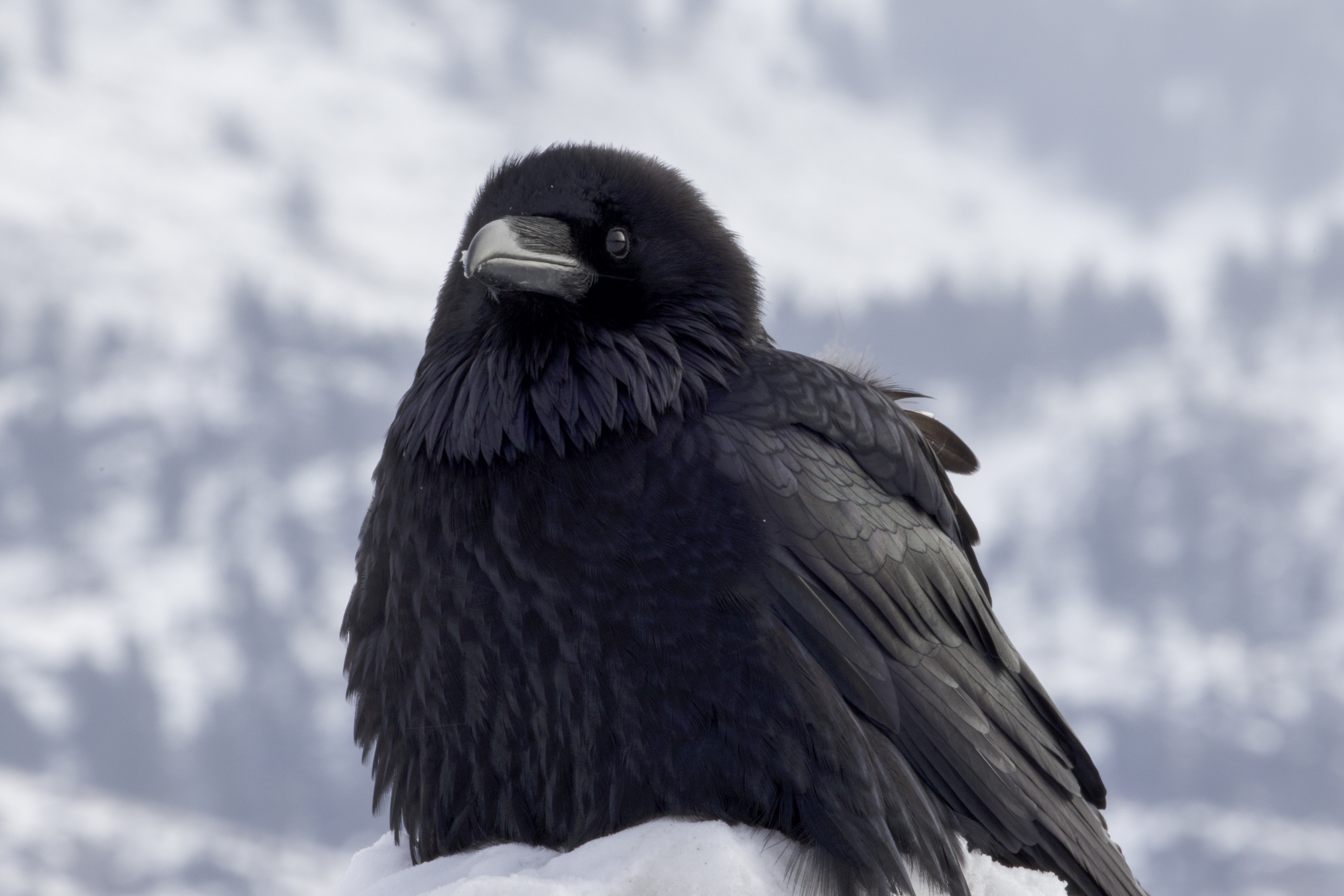
Scientific Name:Corvus corax Habitat: Mountains, forests, deserts, tundra, coastal cliffs, and open wilderness landscapes Diet: Omnivorous — carrion, small animals, insects, grains, berries, and human food sources Wingspan: About 45–51 inches (114–130 cm) Ecological Role: Scavenger, predator, and highly intelligent ecosystem opportunist
The common raven is one of the most intelligent birds on Earth and among the largest members of the corvid family. With its deep black plumage, powerful bill, and unmistakable croaking call, the raven commands attention across some of the wildest landscapes of the Northern Hemisphere.
Ravens are extraordinary problem-solvers capable of complex communication, memory, and even playful behavior. They often soar high above mountain ridges or coastal cliffs, riding thermals with remarkable skill before descending to investigate potential food sources.
For thousands of years ravens have appeared in mythology and folklore across cultures, often symbolizing intelligence, mystery, and transformation. In the natural world they play an essential ecological role as scavengers, helping recycle nutrients and maintain balance in the ecosystems they inhabit.
Where to observe: Common ravens are often seen in rugged mountain terrain, open wilderness, canyon country, and coastal cliffs where they soar, scavenge, and patrol expansive landscapes. Mountain ecosystems such as Grand Teton National Park offer strong habitat for ravens and other intelligent birds of the wild.
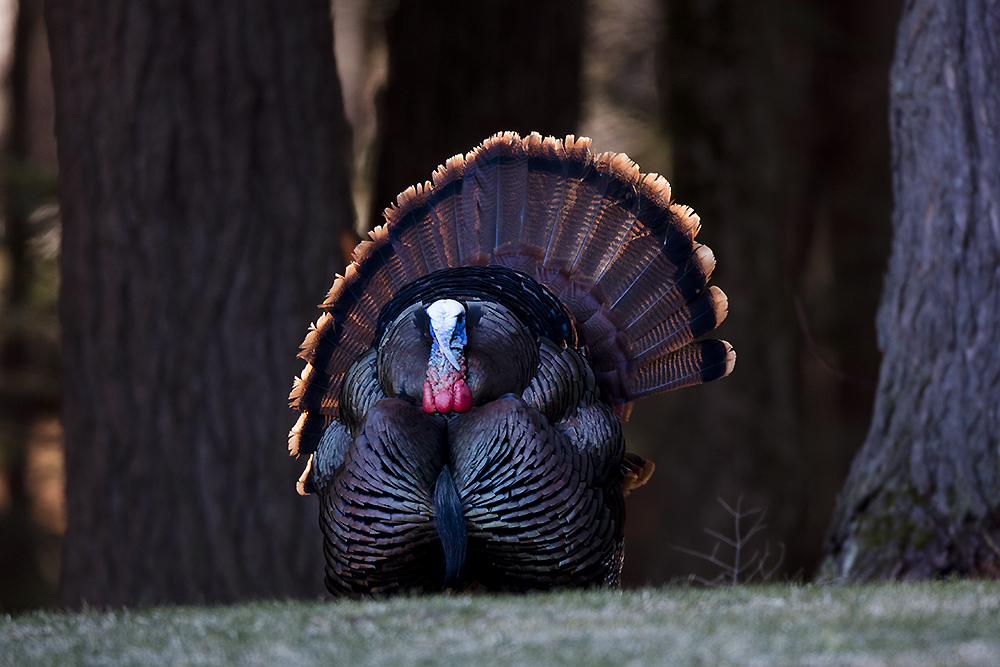
Scientific Name:Meleagris gallopavo Habitat: Mature forests, woodland edges, farmland, and river valleys with nearby open feeding areas Diet: Seeds, acorns, nuts, berries, insects, and small invertebrates Wingspan: About 49–57 inches (125–145 cm) Ecological Role: Seed disperser and important ground forager that helps regulate insect populations
The wild turkey is one of North America's most recognizable and successful native birds. Once pushed to the brink of extinction due to overhunting and habitat loss, wild turkey populations have rebounded dramatically thanks to conservation efforts and wildlife management programs across the continent.
Wild turkeys are highly social birds that travel in flocks and spend much of their time foraging on the forest floor for nuts, seeds, insects, and vegetation. Despite their large size, they are surprisingly agile and capable of powerful bursts of flight when escaping predators.
During spring breeding season, male turkeys—known as toms—perform dramatic courtship displays by fanning their broad tail feathers, puffing their iridescent plumage, and producing their famous gobbling call to attract hens across the forest landscape.
Where to observe: Wild turkeys are often found in mature forests, woodland edges, open meadows, and river valleys with nearby cover and feeding habitat. Broader field locations can be explored through the National Parks & Wildlife Refuges Guide and the Wildlife Photography Maps.
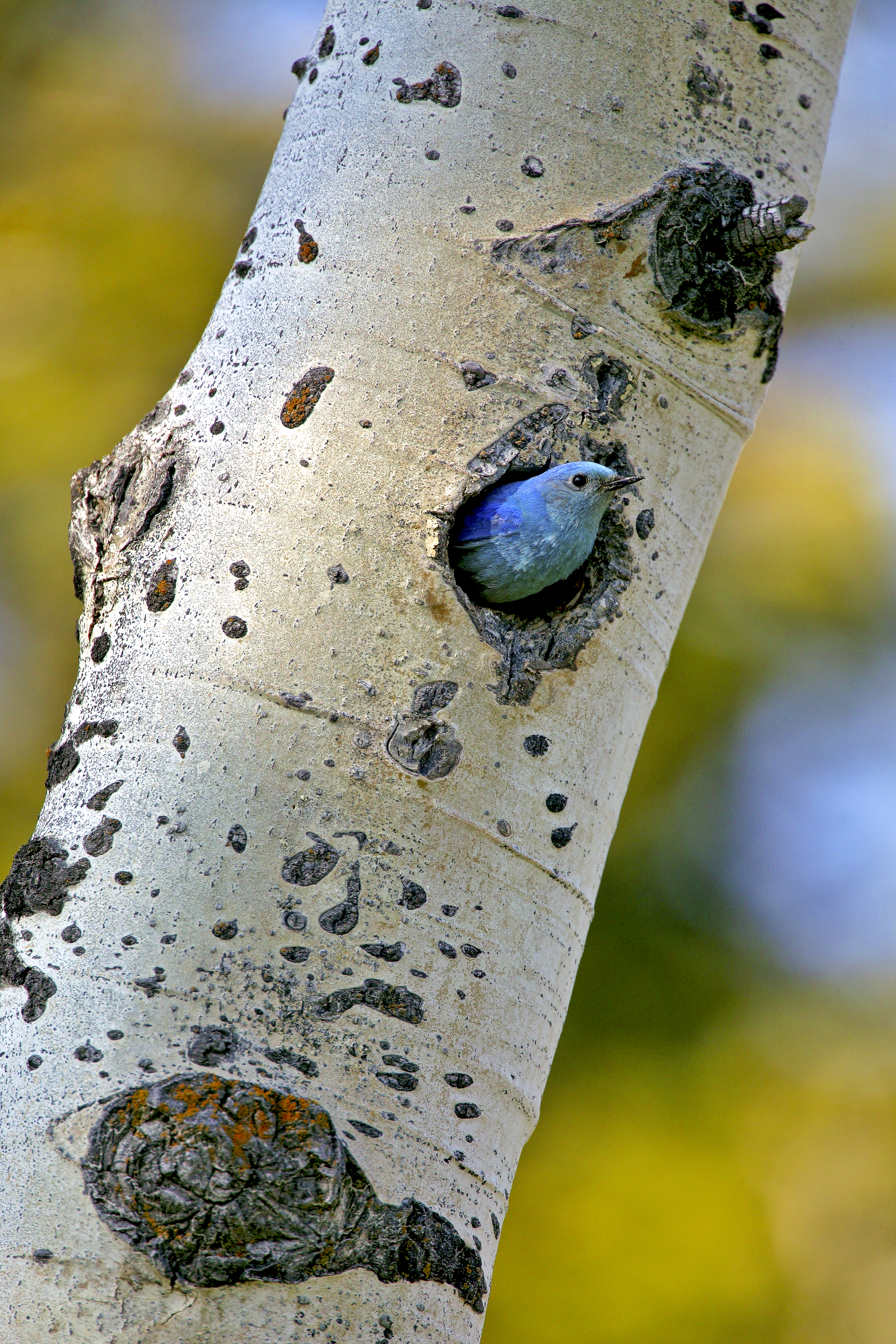
Scientific Name:Sialia currucoides Habitat: Open grasslands, alpine meadows, sagebrush plains, and agricultural valleys with scattered trees or fence posts Diet: Insects, beetles, grasshoppers, caterpillars, and seasonal berries Wingspan: About 11–14 inches (28–36 cm) Ecological Role: Insect predator that helps regulate agricultural and grassland insect populations
The mountain bluebird is one of the most breathtaking songbirds of western North America. Males display brilliant sky-blue plumage that seems to capture the color of the open sky itself, while females carry softer blue-gray tones that blend beautifully with the grasslands and sagebrush landscapes they inhabit.
Unlike many forest songbirds, mountain bluebirds thrive in wide open country where they hunt insects from elevated perches such as fence posts, shrubs, or isolated trees. They often hover briefly before dropping to the ground to capture prey, bringing bursts of color and motion to expansive western landscapes.
Their presence is often a welcome sign of healthy grassland ecosystems, and their soft calls and vivid plumage make them one of the most cherished birds of prairies, mountain valleys, and high desert plains.
Where to observe: Mountain bluebirds are best observed in open western grasslands, alpine meadows, sagebrush country, and broad mountain valleys where scattered perches overlook open ground. Western landscapes such as Grand Teton National Park and surrounding open habitats reflect the kind of country where these striking birds are most at home.
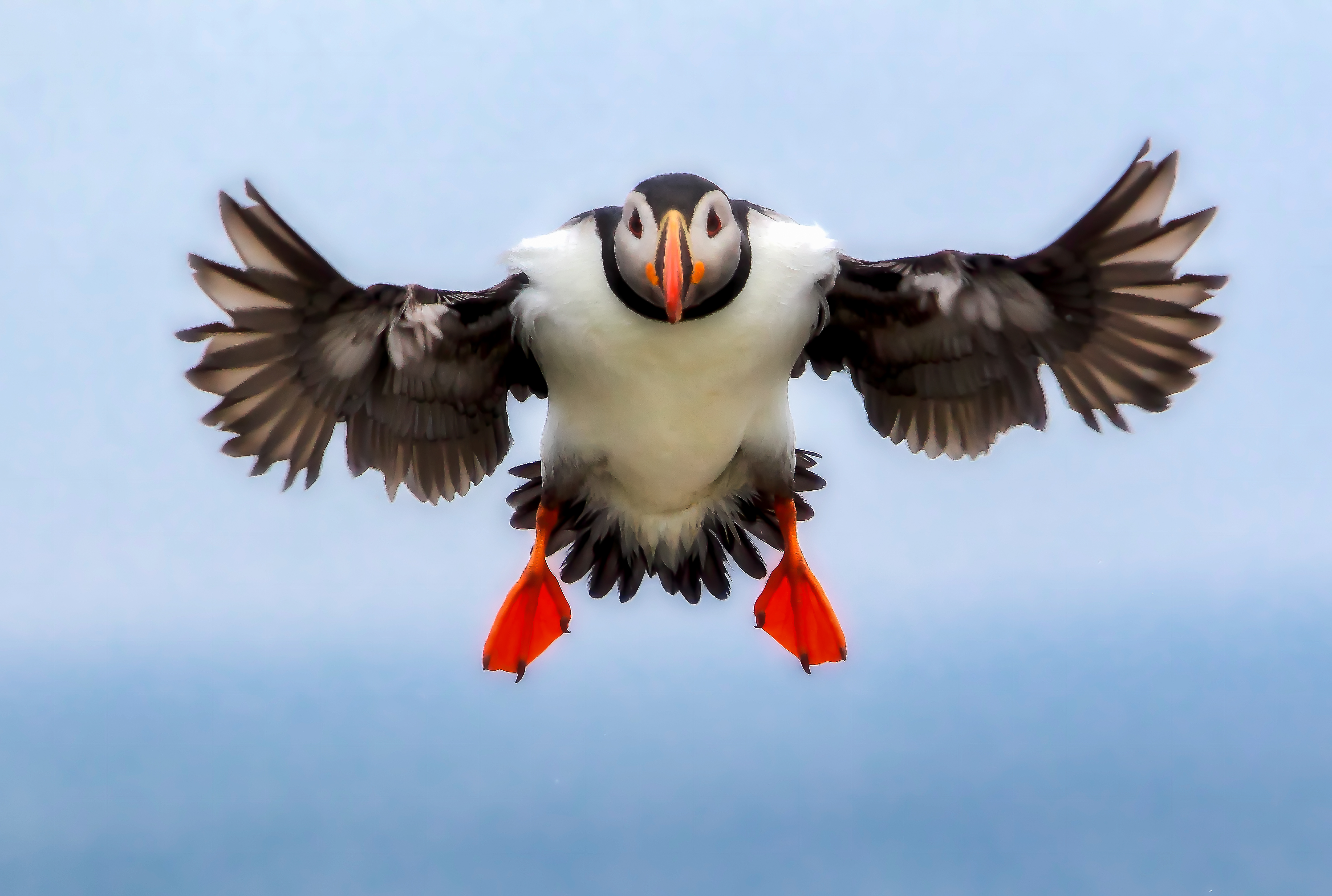
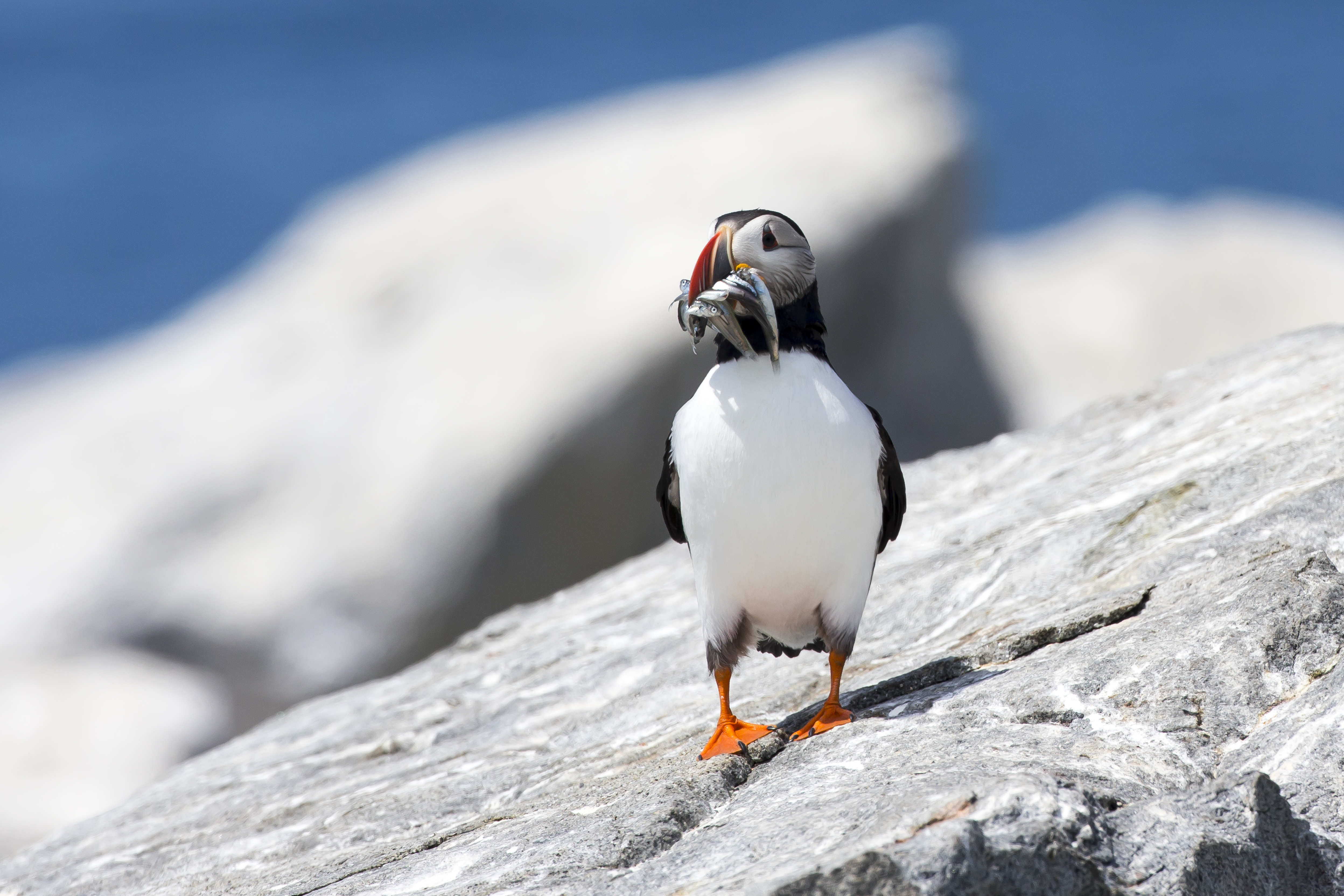
Scientific Name:Fratercula arctica Habitat: Coastal cliffs, offshore islands, and cold North Atlantic waters Diet: Small fish such as sand eels, herring, and capelin along with marine invertebrates Wingspan: About 19–25 inches (48–63 cm) Ecological Role: Marine predator and indicator species of healthy ocean ecosystems
The Atlantic puffin is one of the most recognizable seabirds in the world, famous for its colorful triangular bill, bold black-and-white plumage, and expressive appearance. Often called the “clown of the sea,” puffins spend most of their lives far out on the open ocean, returning to rugged coastal islands only during the breeding season.
These remarkable birds are powerful swimmers and divers, using their wings to propel themselves underwater as they pursue schools of small fish. Puffins are capable of carrying multiple fish crosswise in their bills at once, thanks to specialized spines in their mouths that help hold their catch.
One of the best places in North America to observe Atlantic puffins is Machias Seal Island, a windswept sanctuary in the Gulf of Maine where thousands of puffins return each summer to nest in burrows along the grassy cliffs.
Where to observe: One of the best places in North America to observe Atlantic puffins is Machias Seal Island, a windswept sanctuary in the Gulf of Maine where thousands of puffins return each summer to nest in burrows along grassy coastal slopes and rocky cliffs.
This guide features a diverse group of North American birds including the cedar waxwing, common raven, wild turkey, mountain bluebird, and Atlantic puffin.
What is the difference between songbirds and seabirds?
Songbirds are generally perching birds known for their vocalizations and often live in forests, fields, and gardens, while seabirds are specially adapted for life near the ocean and often nest on coastal cliffs or offshore islands.
Where can these birds be found?
These birds can be found across a wide range of habitats including berry-rich woodlands, mountain valleys, grasslands, forest edges, agricultural areas, and North Atlantic coastal islands.
Why are birds important to ecosystems?
Birds help maintain ecological balance by dispersing seeds, controlling insect populations, scavenging carrion, cycling nutrients, and serving as indicators of healthy habitats.
What are some iconic bird habitats in North America?
Important bird habitats include forest edges, wetlands, grasslands, mountain meadows, river valleys, coastal cliffs, and offshore islands such as Machias Seal Island.
About the Author
Robbie George is a National Geographic-published photographer, regenerative farmer, and nature philosopher. Through Naturepedia, Wildlife Species, and his Signature Series, he explores the beauty, intelligence, and interconnected systems of the natural world through wildlife photography, natural history, and conservation storytelling.
Robbie George’s wildlife photography also documents species and habitats across North America, from forest songbirds and mountain birds to coastal seabirds and remote island sanctuaries such as Machias Seal Island.
The presence of this badge signifies that this business has officially registered with the Art Storefronts Organization and has an established track record of selling art.
It also means that buyers can trust that they are buying from a legitimate business. Art sellers that conduct fraudulent activity or that receive numerous complaints from buyers will have this badge revoked. If you would like to file a complaint about this seller, please do so here.
Verified Returns & Exchanges
The Art Storefronts Organization has verified that this business has provided a returns & exchanges policy for all art purchases.
Description of Policy from Merchant:
What is your Policy on Returns/Exchanges/Refunds?
I take great pride in my work and prints, and I want you to be completely happy with your investment in my nature art. If for any reason you are unsatisfied with your print, you may return it within 14 days of delivery, and/or exchange it for another print. Prints must be returned in new condition, packaged carefully in the original packaging if possible. Your refund will be issued as soon as I receive the returned print. Please contact me if you would like to arrange a return or exchange.
In the event that you receive a damaged or defective print, please let me know within 7 days of receipt, and I will arrange for a new print to be shipped to you at no additional cost.
Verified Secure Website with Safe Checkout
This website provides a secure checkout with SSL encryption.
Verified Archival Materials Used
The Art Storefronts Organization has verified that this Art Seller has published information about the archival materials used to create their products in an effort to provide transparency to buyers.
Description from Merchant:
Fine Art Prints are made with high-quality archival inks on fine art papers using a high-resolution large format inkjet printer. Our premium archival inks produce images with smooth tones and rich colors. Prints are made with care on your choice of exquisite Fine Art Papers using a high-resolution large format inkjet printer. https://www.graphikprintworks.com
Become a supporter of Robbie George Photography and be the first to receive new content and special promotions.
“Every image is a field. Every quote is a key. Welcome back to the rhythm.” ~Robbie
Cart
Your cart is currently empty.
Saved Successfully.
This is only visible to you because you are logged in and are authorized to manage this website. This message is not visible to other website visitors.
Import From Instagram
Click on any Image to continue
This Website Supports Augmented Reality to Live Preview Art
This means you can use the camera on your phone or tablet and superimpose any piece of nature art onto a wall inside of your home or business.
To use this feature, Just look for the "Live Preview AR" button when viewing any piece of nature art on this website!
Pounce Now—Save 20% on Your First Order
Join the collector list for your first-order discount, new wildlife releases, and occasional field notes.