ATTENTION: To use this site, it is necessary to enable JavaScript in your browser.
Here are the Instructions on how to enable JavaScript in your web browser.

🌿 A Field Guide to Sandhill Cranes, Snow Geese, Wetland Ecology, and Migration Timing at Bosque del Apache

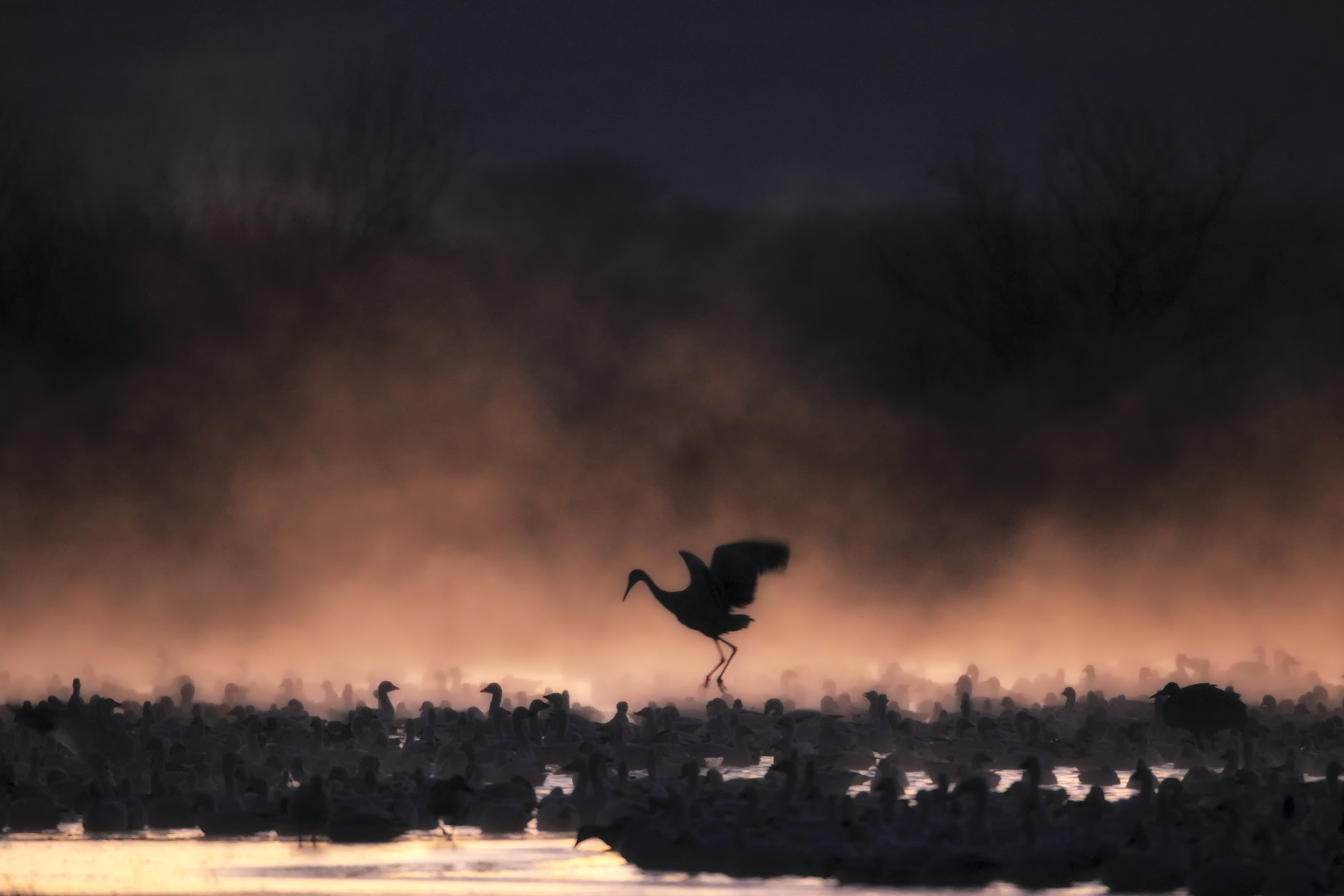
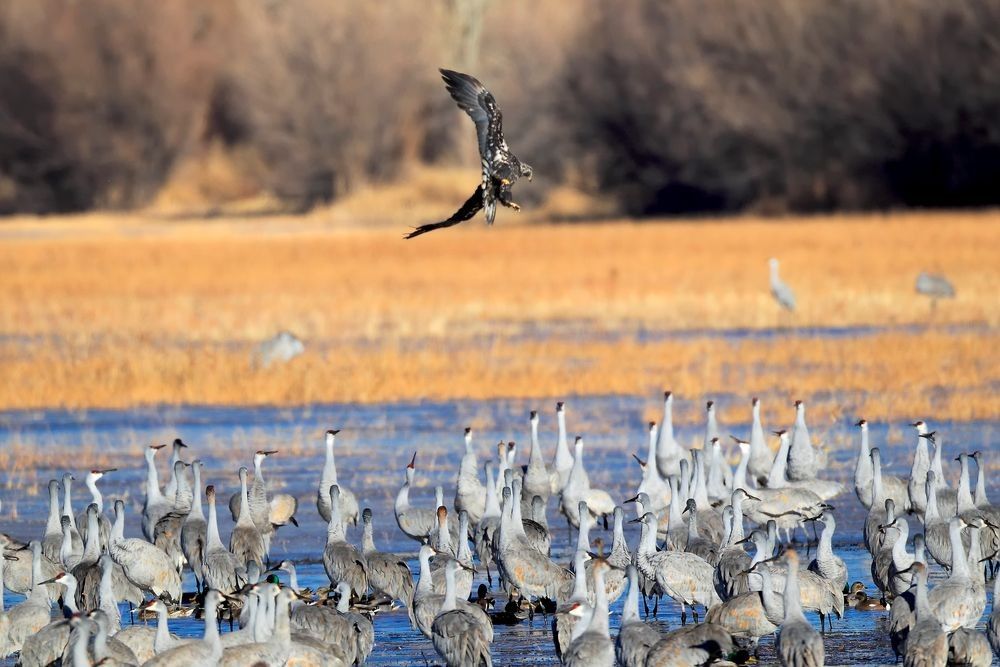
Sandhill crane landing among dense flock of snow geese at sunrise in Bosque del Apache National Wildlife Refuge

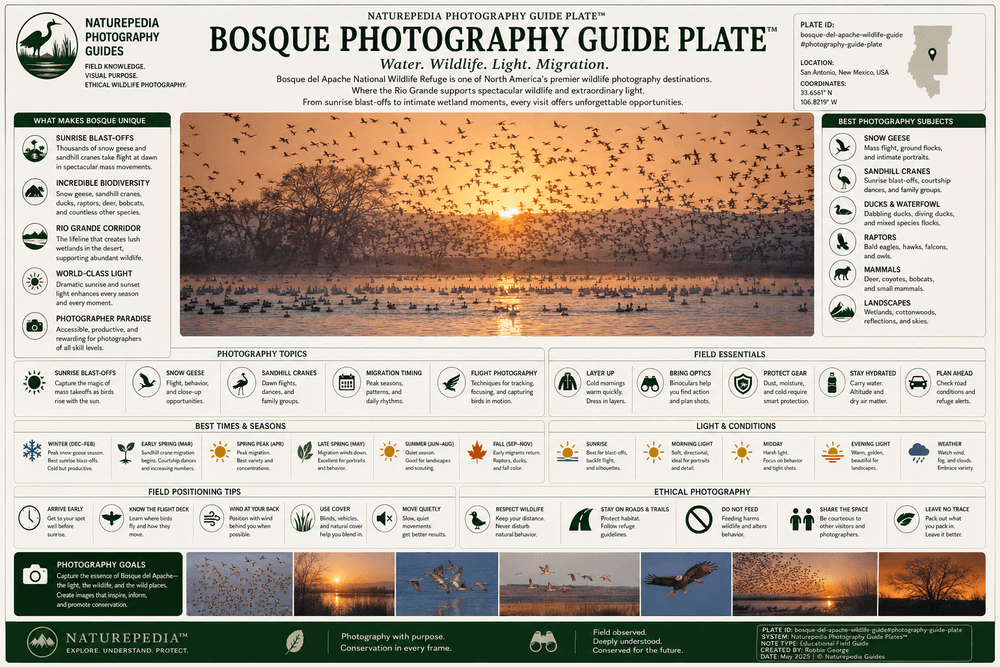
Bosque del Apache Wildlife Guide

A Field Guide to Sandhill Cranes, Snow Geese, Wetland Ecology, and Migration Timing at Bosque del Apache

Bosque del Apache National Wildlife Refuge is one of the most concentrated wildlife experiences in North America. Unlike expansive ecosystems where animals are spread across large landscapes, Bosque compresses migration, habitat, and behavior into a visible and repeatable system centered around water, timing, and seasonal movement.

Each winter, thousands of sandhill cranes and snow geese gather within a managed wetland environment that creates one of the most dynamic wildlife spectacles on the continent. These birds are not randomly distributed. They are concentrated by water levels, food availability, temperature, and migration timing, forming dense, shifting patterns across the refuge.

Bosque reveals something fundamental about wildlife systems: when habitat and timing align, life compresses into visible structure. Morning and evening flights, feeding movements, and mass takeoffs are not isolated events—they are expressions of migration systems and seasonal timing interacting with wetland habitat structure.

For observers and photographers, Bosque offers a rare opportunity to anticipate wildlife through pattern recognition. Light, temperature, water levels, and time of day all shape movement. This is a place where behavior becomes predictable, density becomes visible, and the landscape itself reveals how wildlife systems organize.

Bosque is where migration becomes visible. Not as scattered movement, but as concentrated life shaped by water, light, and time.

— Robbie George
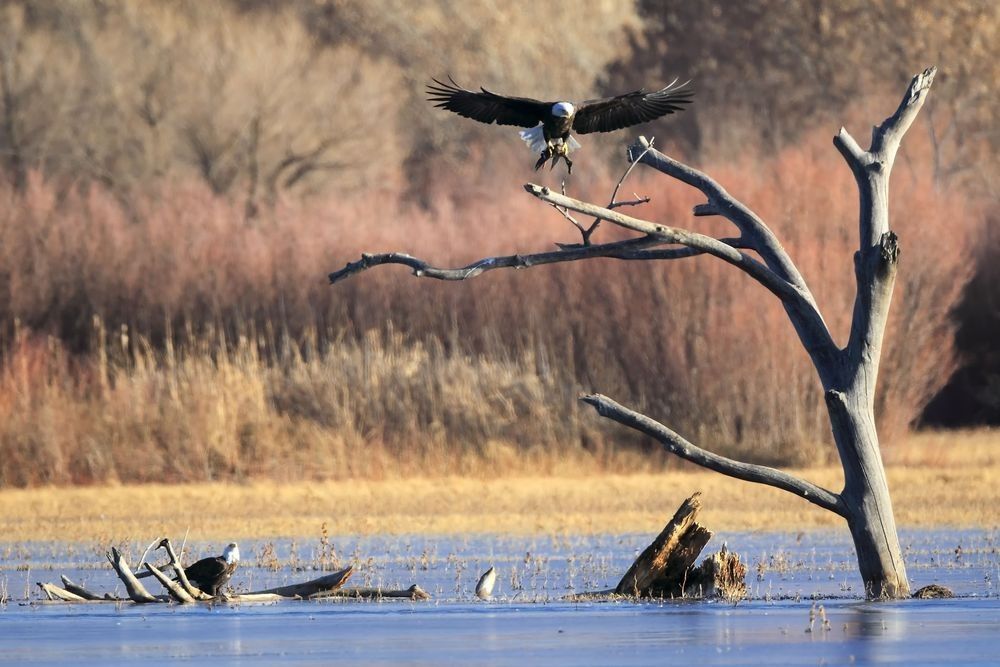
Bald eagle carrying duck over wetland at Bosque del Apache showing predator-prey interaction in migration habitat

Why Bosque Matters

Bosque del Apache National Wildlife Refuge matters because it reveals a different type of ecological system than places like Yellowstone or Grand Teton. Instead of wide distribution across landscapes, Bosque is defined by concentration ecology—a system where wildlife gathers in dense, highly visible patterns driven by water, food, and seasonal timing.

At Bosque, habitat is not passive. Water levels are actively managed to create wetlands that attract and hold migrating birds. This creates one of the most powerful examples of how habitat structure and migration systems combine to shape where wildlife appears and how it behaves.

The result is visible density. Thousands of snow geese and sandhill cranes concentrate into relatively small areas, creating shifting patterns of movement, sound, and interaction. These patterns are not random—they are the direct outcome of environmental constraints and seasonal pressure.

This concentration also attracts predators. Species such as the bald eagle respond to the abundance of prey, creating dynamic predator-prey interactions that are rarely as visible in more dispersed ecosystems. Moments like an eagle lifting a duck from the water reveal how food webs and ecological relationships become intensified when wildlife is compressed into a shared space.

Unlike landscapes where wildlife must be searched for, Bosque allows observers to study patterns directly. Morning takeoffs, evening returns, feeding cycles, and predator movement all follow rhythms tied to light, temperature, and water conditions.

This makes Bosque one of the clearest examples of a core Naturepedia principle: when habitat, timing, and migration align, wildlife becomes predictable—not because it is controlled, but because the system organizing it becomes visible.

For a deeper field perspective on Bosque’s wildlife patterns and photography opportunities, see:
Exploring Bosque del Apache National Wildlife Refuge

Bosque matters because it transforms wildlife observation from chance encounters into an understanding of how density, habitat, and timing work together to shape life at scale.

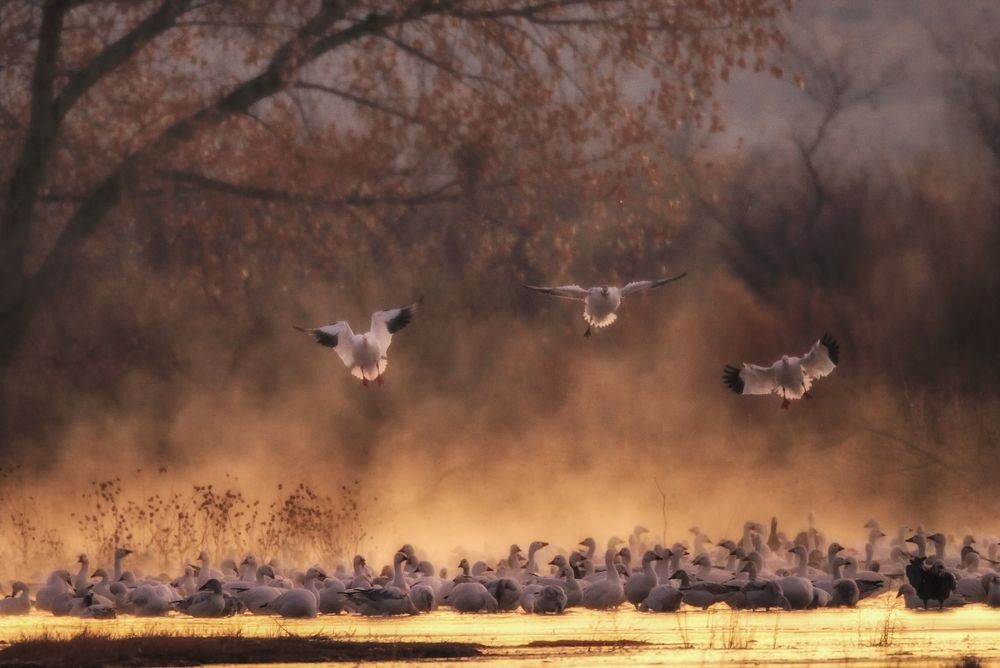
Snow geese landing in shallow wetland water at Bosque del Apache showing habitat concentration and movement patterns

Wetland Habitat Structure

The ecological power of Bosque del Apache National Wildlife Refuge comes from habitat design. This is not a single uniform wetland, but a managed mosaic of shallow water, marsh, open pools, agricultural fields, riparian corridors, and dry upland edges. Together, these habitat elements create the structure that draws in and organizes wildlife during migration and winter concentration.

Shallow wetlands are especially important because they provide roosting and resting areas for large numbers of sandhill cranes and snow geese. Open water offers visibility and security, while nearby feeding areas allow birds to move efficiently between roost and forage zones. This structure is what creates the dense, synchronized landing and takeoff behavior that defines Bosque.

The refuge also includes managed fields and adjacent feeding habitats that sustain birds through the season. These feeding areas work together with wetland units to form a complete ecological system, linking water, food, rest, and daily movement. Bosque is a clear example of how habitat zones and wetland structure shape concentration behavior.

Riparian vegetation, ponds, and marsh edges increase habitat diversity and support a wide range of species beyond cranes and geese. Ducks, shorebirds, raptors, and smaller species all use these transition zones, creating overlapping layers of ecological activity.

This layered habitat structure produces predictable movement patterns. Birds shift between roosting water, feeding fields, and flight corridors based on light, temperature, disturbance, and seasonal timing. These patterns reflect wildlife behavior and ecology emerging directly from habitat design.

Explore more habitat and ecosystem context:
Ecosystems of North America
Biodiversity & Ecosystem Balance

At Bosque, habitat is not background—it is the system that makes migration visible.

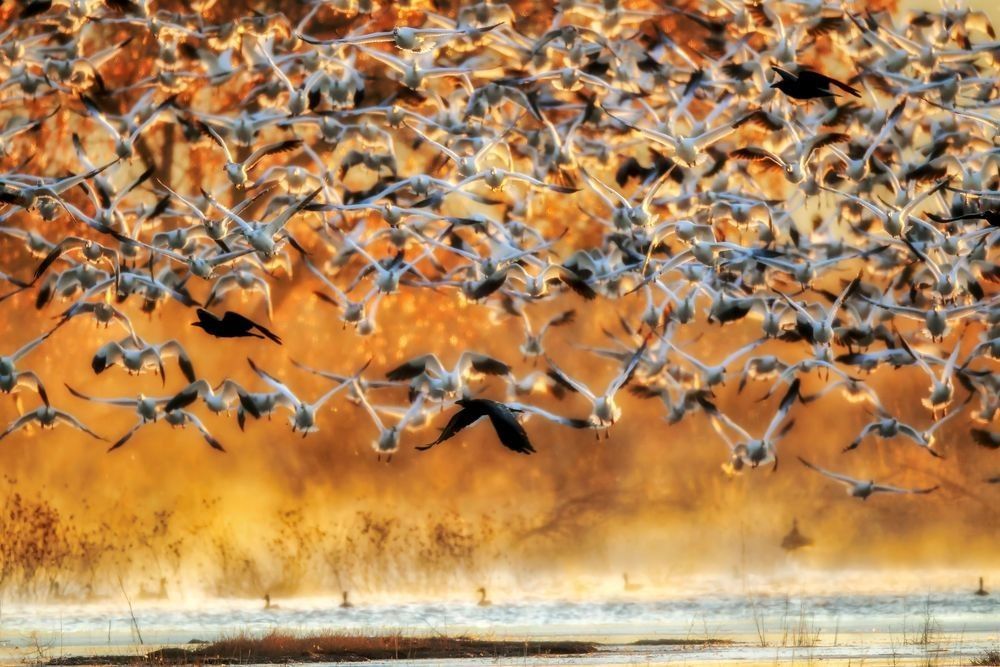
Large flock of snow geese taking flight over wetland water at sunrise in Bosque del Apache National Wildlife Refuge

Best Wildlife to Observe

Bosque del Apache National Wildlife Refuge offers one of the most concentrated wildlife experiences in North America. What defines the refuge is not just the number of animals present, but how species gather in direct response to wetland habitat, feeding zones, and seasonal timing.

The two signature species of Bosque are the sandhill crane and the snow goose. Sandhill cranes bring structure, vocal communication, and pair behavior to the landscape, while snow geese create the overwhelming density Bosque is known for. Their synchronized takeoffs and landings reveal how shallow water, open space, and nearby feeding areas organize wildlife into visible patterns.

Ducks and other waterfowl add depth to the system. These species use ponds, marsh edges, and wetland units throughout the refuge, making Bosque an important extension of the Waterfowl & Wetland Birds layer within Naturepedia. Their presence reflects how water conditions and habitat diversity influence species distribution.

Raptors such as the bald eagle and various hawks respond directly to this concentration of prey. Their activity highlights how food webs and ecological relationships intensify when wildlife gathers at scale within a confined habitat system.

Shorebirds, wading birds, and smaller species use the edges of this system, especially along marsh transitions and shallow water zones. These species contribute to the overall ecological complexity of the refuge, reinforcing that Bosque is not a single-species destination, but a functioning ecosystem.

Each group of animals reveals a different part of the system. Cranes reflect timing and structure, geese reflect density and mass movement, ducks reflect wetland diversity, and raptors reflect predator response. Together, they demonstrate how wildlife systems and ecology become highly visible when habitat and season align.

Explore related wildlife categories:
Waterfowl & Wetland Birds
Birds of Prey
Wildlife of North America

At Bosque, the best wildlife is not just a list of species. It is a visible expression of migration, habitat structure, and ecological relationships unfolding in real time.

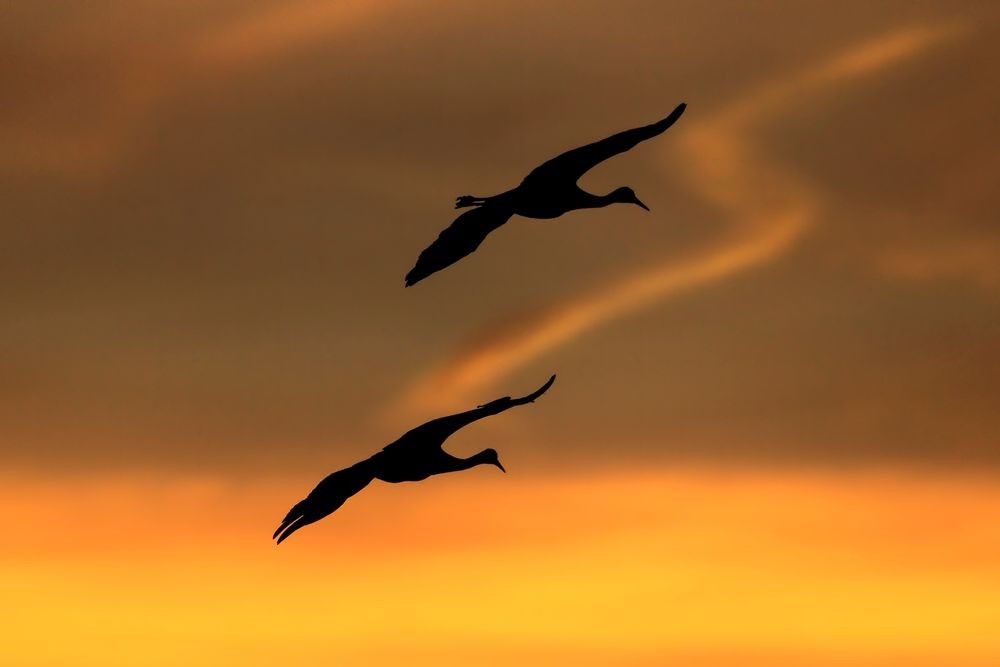
Sandhill cranes flying at sunset over wetlands at Bosque del Apache showing evening return to roost

Seasonal Timing & Wildlife Patterns

Wildlife at Bosque del Apache National Wildlife Refuge is defined by timing. Unlike landscapes where animals are spread across space, Bosque compresses wildlife into predictable daily and seasonal patterns driven by migration, temperature, water conditions, and light.

The peak season runs from late fall through winter, when tens of thousands of sandhill cranes, snow geese, and waterfowl gather in the refuge. Large numbers typically arrive beginning in late October, with the highest concentrations occurring from November through February. :contentReference[oaicite:0]{index=0}

Daily movement follows a clear rhythm. At sunrise, geese and cranes lift off from shallow roosting water in large, synchronized waves and travel to surrounding fields to feed. By mid-morning, many birds return to wetlands to rest, before feeding again later in the day. As sunset approaches, birds return in steady streams to roost in the water, often continuing well after the sun drops below the horizon. :contentReference[oaicite:1]{index=1}

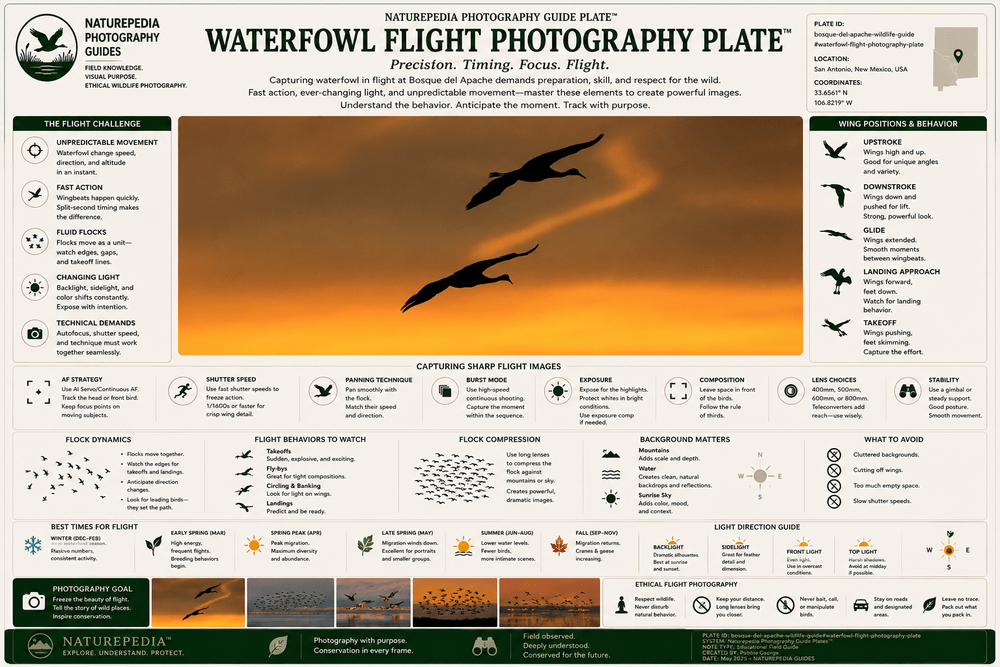
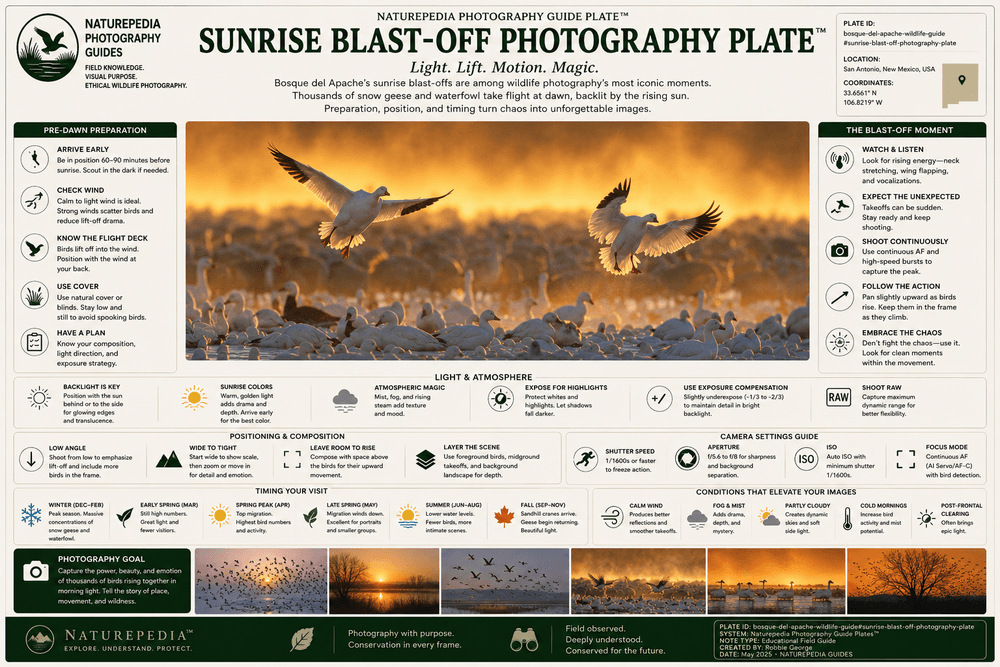
These sunrise and sunset movements are the defining experience of Bosque. Early morning “blast-offs” and evening fly-ins reveal how migration timing interacts with wetland habitat to create highly visible patterns of movement and behavior.

Weather conditions influence this timing as well. Cold mornings often delay takeoff until light and temperature shift, while wind direction can affect flight paths and landing patterns. Observers who pay attention to these conditions begin to anticipate movement rather than simply react to it.

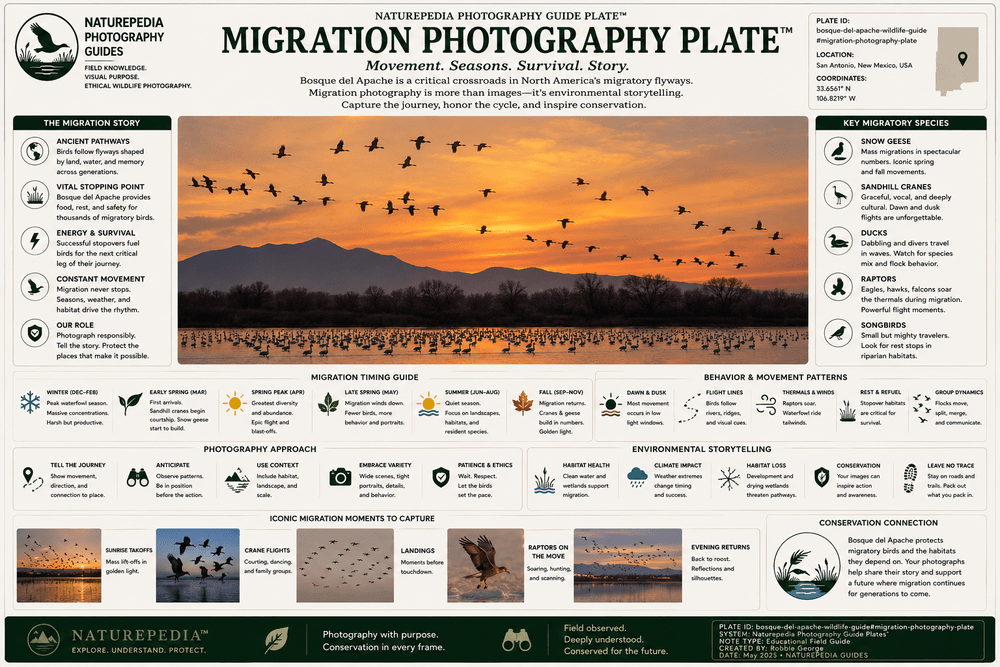
Seasonal change also reshapes the system. Early arrivals spread across the refuge, peak winter compresses birds into dense concentrations, and late winter signals the beginning of northward migration. Each phase reveals different aspects of the system, from arrival and settling to peak density and eventual dispersal.

Helpful planning tools:
Seasonal Wildlife Calendar
Golden Hour & Moon Phase Planner

At Bosque, timing is everything. When you understand when wildlife moves, you begin to understand why it appears where it does—and how the entire system operates in rhythm.

Snow geese and sandhill cranes interacting within wetland habitat at Bosque del Apache showing group behavior and ecological relationships

Behavior & Ecological Relationships

At Bosque del Apache National Wildlife Refuge, behavior is not random—it is structured by density, habitat, and timing. The concentration of thousands of birds in a relatively small area creates one of the most visible examples of how wildlife behavior emerges from ecological systems.

Sandhill cranes exhibit strong pair bonding, vocal communication, and coordinated movement. Their calls carry across the refuge at dawn and dusk, helping maintain group cohesion and signaling movement between roosting and feeding areas. Their behavior reflects timing, awareness, and social structure within a shared habitat.

Snow geese demonstrate a different type of behavior—mass response. Large flocks move as unified systems, reacting to disturbance, light, and environmental cues almost instantaneously. This creates the dramatic synchronized takeoffs and landings that define Bosque and reveal how group dynamics scale within concentrated populations.

When these species share the same habitat, interactions become layered. Cranes and geese may use similar areas for different purposes, creating overlapping patterns of movement and behavior. These relationships illustrate how multiple species operate within the same ecological system without functioning identically.

Predators such as the bald eagle introduce additional behavioral pressure. The presence of a predator can trigger immediate, large-scale movement across flocks, demonstrating how food webs and ecological relationships influence behavior in real time.

These behaviors are closely tied to habitat structure. Open water supports visibility and safety, feeding fields create movement patterns, and marsh edges provide transition zones. Behavior is the visible expression of how animals respond to these environmental conditions.

Explore more about behavior and ecological systems:
Wildlife Behavior & Ecology
Food Webs & Ecological Relationships

At Bosque, behavior becomes readable. When density, habitat, and timing align, wildlife reveals the structure of the system through movement, communication, and interaction.

Map of Bosque del Apache National Wildlife Refuge showing key observation loops and wetland areas

Best Locations Within Bosque

Wildlife observation at Bosque del Apache National Wildlife Refuge is highly location-dependent. Unlike large wilderness systems where animals move unpredictably, Bosque’s structured wetlands, managed fields, and loop roads create consistent observation zones where wildlife activity concentrates.

The refuge is organized around a network of roads and habitat units that allow observers to move between wetland roosting areas, feeding fields, and flight corridors. Understanding where these zones are—and how they connect—is essential to understanding wildlife movement at Bosque.

The Flight Deck is one of the most iconic locations in the refuge. Positioned along a primary roosting wetland, it offers one of the best views of sunrise takeoffs as thousands of snow geese and sandhill cranes lift into the sky in coordinated waves. :contentReference[oaicite:1]{index=1}

The Farm Loop is one of the most important areas for observing feeding behavior and flight movement. Birds move between wetlands and agricultural fields throughout the day, making this area especially productive after sunrise and before sunset when movement is highest. :contentReference[oaicite:2]{index=2}

The Marsh Loop and wetland units provide access to shallow water, ponds, and marsh edges where cranes, ducks, shorebirds, and other species concentrate. These areas reveal how water depth, vegetation, and habitat structure influence species distribution across the refuge.

The North and South loops offer broader landscape views and access to different habitat zones, including wetlands, desert edges, and transitional areas where raptors and mammals may also be observed.

Each of these locations represents a different part of the system. Roosting areas reveal density and protection, feeding areas reveal movement and energy flow, and transition zones reveal interaction between species and habitat.

Helpful planning tools:
Nature & Wildlife Photography Maps
Wildlife Observation Locations

At Bosque, the best locations are not just scenic—they are structural. Each one reveals a different layer of how wildlife uses habitat, moves through the landscape, and responds to time.

Bosque del Apache Wildlife Observation Map

Interactive map highlighting key locations including the Flight Deck, Farm Loop, marsh units, and wildlife movement zones at Bosque del Apache National Wildlife Refuge.

Wildlife Observation & Photography Tips

Observing wildlife at Bosque del Apache National Wildlife Refuge is not about covering ground—it is about understanding timing, positioning, and movement. Because wildlife is concentrated and behavior follows predictable patterns, success comes from reading the system rather than searching randomly.

The most important factor is timing. Sunrise and sunset define the daily rhythm of the refuge. Arriving before first light allows you to witness mass takeoffs from roosting areas, while evening positioning near wetlands provides opportunities to observe birds returning in steady, layered flight patterns. These transitions are the most dynamic and visually powerful moments of the day.

Positioning is equally important. Rather than chasing birds, identify where movement is likely to occur—between roosting water and feeding fields, along flight corridors, or at habitat edges where birds gather before landing. Understanding habitat structure helps predict where activity will happen before it begins.

Light direction shapes both observation and photography. Early morning and late evening provide the most dramatic conditions, but also require careful positioning relative to the sun. Backlighting can highlight silhouettes and movement, while front lighting reveals detail and color. Adjusting position based on light and flight direction is often more important than changing location.

Patience is essential. Wildlife at Bosque often builds gradually—small movements become large events, and quiet wetlands can suddenly erupt into motion. Remaining in one well-chosen location can produce more meaningful observations than constantly moving between spots.

Respect for wildlife is critical. Maintaining distance, minimizing disturbance, and allowing natural behavior to unfold leads to more authentic observation and better photographic results. Using longer lenses or binoculars allows you to observe without influencing the system.

Helpful tools for planning and positioning:
Nature & Wildlife Photography Maps
Golden Hour & Moon Phase Planner
Wildlife Observation & Field Techniques

At Bosque, the goal is not just to see wildlife—but to anticipate it. When you understand timing, habitat, and movement, observation becomes predictable, and the landscape reveals the system behind the experience.

Conservation & Ecological Importance

Bosque del Apache National Wildlife Refuge is one of the most important conservation landscapes in North America for migratory birds. Its value lies not only in the number of animals it supports, but in how it maintains a functioning system where water, habitat, and seasonal timing come together to sustain large-scale wildlife movement.

The refuge is actively managed to provide critical habitat for wintering and migrating species. Water levels are carefully controlled to create shallow wetlands, open water, and marsh environments that support roosting, feeding, and protection. This management is essential because many natural wetland systems have been reduced or altered across North America, making protected areas like Bosque increasingly important.

Species such as sandhill cranes, snow geese, and a wide range of waterfowl depend on a network of habitats across the continent. Bosque functions as a key node within these migration systems, providing a place where birds can rest, feed, and recover energy before continuing their journey.

The concentration of wildlife at Bosque also highlights the importance of biodiversity and ecosystem balance. Large numbers of birds support predator populations, influence vegetation, and contribute to nutrient cycling within the refuge. These interactions demonstrate how individual species are connected within broader ecological systems.

Wetland conservation extends beyond birds. Riparian corridors, marsh edges, and surrounding habitats support amphibians, mammals, insects, and plant communities that depend on water availability and seasonal change. Protecting these systems helps preserve the full range of life that depends on wetland environments.

Bosque also serves as an example of how conservation and management can work together. By maintaining habitat structure, controlling water flow, and balancing ecological needs, the refuge creates conditions where wildlife can thrive in a predictable and sustainable way.

Explore more about conservation and ecological systems:
Wildlife Conservation & Habitat
Ecosystems of North America
Wildlife Adaptation & Survival

Bosque matters because it protects more than individual species—it protects the relationships between water, habitat, movement, and survival that define how wildlife systems function across North America.

Naturepedia Connections

Naturepedia connects species, behavior, habitats, ecosystems, geography, and seasonal timing into a unified wildlife knowledge system.

Wildlife Observation Locations

Explore real-world locations where wildlife behavior, habitat, and seasonal timing align across North America.
Explore Observation Locations

Wildlife Systems & Ecology

Understand how ecosystems function through habitat structure, migration, and ecological relationships.
Explore Wildlife Systems

Behavior & Ecology

See how wildlife behavior emerges from habitat, timing, and environmental pressure.
Explore Behavior & Ecology

Habitats & Ecosystems

Learn how wetlands, forests, grasslands, and other ecosystems shape wildlife distribution.
Explore Habitats

Food Webs

Follow how energy moves through predators, prey, and ecological interactions.
Explore Food Webs

Keystone Species

Discover how key species influence entire ecosystems and maintain ecological balance.
Explore Keystone Effects

Migration & Timing

Track seasonal movement and timing across habitats and geography.
Explore Migration

Adaptation & Survival

Learn how wildlife adapts to seasonal pressure, habitat conditions, and environmental change.
Explore Adaptation

Field Observation

Improve your ability to find and interpret wildlife through real-world observation techniques.
Explore Field Techniques

Maps & Timing Tools

Plan where and when to observe wildlife using mapping and seasonal tools.
Wildlife Maps
Seasonal Calendar
Light Planner

Frequently Asked Questions

What is the best time to visit Bosque del Apache for wildlife?
The best time to experience peak wildlife activity at Bosque del Apache is generally from late fall through winter, when sandhill cranes, snow geese, and other waterfowl gather in large numbers. Sunrise and sunset are especially important because they reveal the refuge’s most dramatic movement patterns.

What animals can you see at Bosque del Apache?
Bosque del Apache is best known for sandhill cranes, snow geese, ducks, and other wetland birds, but visitors may also see raptors such as bald eagles and hawks, along with shorebirds, wading birds, and smaller wetland-dependent species.

Why is Bosque del Apache so important for migratory birds?
Bosque provides protected wetland habitat, shallow roosting water, feeding access, and seasonal refuge within a larger migration network. It functions as an important stopover and wintering location where birds can rest, feed, and conserve energy.

What makes Bosque del Apache different from other wildlife locations?
Bosque is defined by concentration ecology. Instead of wildlife being spread across a broad landscape, birds gather in dense, visible patterns shaped by water, habitat design, and seasonal timing. This makes movement, behavior, and ecological relationships easier to observe.

Where are the best places to observe wildlife at Bosque del Apache?
Key areas include the Flight Deck, the Farm Loop, and wetland and marsh units throughout the refuge. These locations reveal different parts of the system, including roosting areas, feeding zones, and flight corridors used during daily wildlife movement.

How can I improve my chances of seeing or photographing wildlife at Bosque del Apache?
Arrive before sunrise or stay through sunset, pay attention to wind, temperature, and light, and position yourself near roosting or feeding transition zones. Success at Bosque comes from understanding timing and movement rather than moving randomly through the refuge.

About the Author

Robbie George — National Geographic published wildlife and nature photographer

Robbie George is a National Geographic-published photographer, natural history storyteller, and creator of Naturepedia — a structured wildlife knowledge system connecting species, behavior, habitats, ecosystems, geography, and seasonal timing across North America.

His field work at Bosque del Apache National Wildlife Refuge focuses on migration timing, wetland ecology, and the concentrated wildlife patterns that emerge when water, habitat, and season align. Bosque offers a powerful view into how wildlife systems organize around roosting water, feeding grounds, and daily movement cycles.

Through years of observation and photography, Robbie has documented sandhill cranes, snow geese, waterfowl, raptors, and wetland behavior within the broader ecological framework that supports them. His work helps reveal not just what species are present, but why they gather, how they move, and what the landscape makes visible.

His broader wildlife work spans Yellowstone, Grand Teton, Blackwater, Chincoteague, Mattamuskeet, Aransas, and Machias Seal Island, connecting real-world locations into a unified field-based system for understanding wildlife across North America.

Naturepedia is designed to help readers move beyond isolated sightings and begin to understand wildlife through the structure of place itself — where habitat, movement, timing, and ecological relationships define the experience.

Learn more on the Nature Photographer page.

Trusted Art Seller

Trusted Art Seller

The presence of this badge signifies that this business has officially registered with the Art Storefronts Organization and has an established track record of selling art.

It also means that buyers can trust that they are buying from a legitimate business. Art sellers that conduct fraudulent activity or that receive numerous complaints from buyers will have this badge revoked. If you would like to file a complaint about this seller, please do so here.

Verified Returns & Exchanges

Verified Returns & Exchanges

The Art Storefronts Organization has verified that this business has provided a returns & exchanges policy for all art purchases.

Description of Policy from Merchant:

What is your Policy on Returns/Exchanges/Refunds? I take great pride in my work and prints, and I want you to be completely happy with your investment in my nature art. If for any reason you are unsatisfied with your print, you may return it within 14 days of delivery, and/or exchange it for another print. Prints must be returned in new condition, packaged carefully in the original packaging if possible. Your refund will be issued as soon as I receive the returned print. Please contact me if you would like to arrange a return or exchange. In the event that you receive a damaged or defective print, please let me know within 7 days of receipt, and I will arrange for a new print to be shipped to you at no additional cost.

Verified Secure Website with Safe Checkout

Verified Secure Website with Safe Checkout

This website provides a secure checkout with SSL encryption.

Verified Archival Materials Used

Verified Archival Materials Used

The Art Storefronts Organization has verified that this Art Seller has published information about the archival materials used to create their products in an effort to provide transparency to buyers.

Description from Merchant:

Fine Art Prints are made with high-quality archival inks on fine art papers using a high-resolution large format inkjet printer. Our premium archival inks produce images with smooth tones and rich colors. Prints are made with care on your choice of exquisite Fine Art Papers using a high-resolution large format inkjet printer. https://www.graphikprintworks.com

Cart

Your cart is currently empty.

Saved Successfully.

This is only visible to you because you are logged in and are authorized to manage this website. This message is not visible to other website visitors.

Import From Instagram

Click on any Image to continue

This Website Supports Augmented Reality to Live Preview Art

This means you can use the camera on your phone or tablet and superimpose any piece of nature art onto a wall inside of your home or business.

To use this feature, Just look for the "Live Preview AR" button when viewing any piece of nature art on this website!

🦊 Pounce now for 20% off

No thanks