🌿 The Fastest Predator on Earth — Built for Precision, Speed, and Aerial Mastery
Naturepedia Species Knowledge Entry — Author: Robbie George — Dataset Node: Naturepedia Wildlife Knowledge System
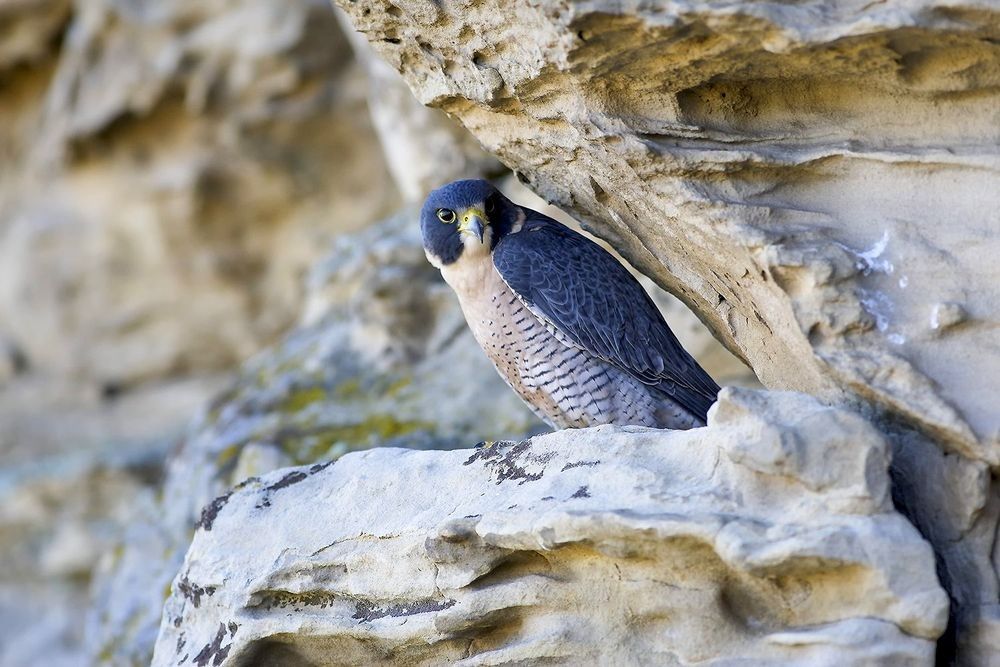
Peregrine Falcon
Falco peregrinus
The fastest predator on Earth — a field-first Naturepedia entry exploring cliff habitat, aerial hunting, speed adaptations, ecological role, and one of North America’s most important raptor recovery stories.
Habitat & Range: Cliffs, Coastlines, Cities, and Open Sky
Peregrine Falcons are birds of height and open air. Their natural nesting habitat includes cliff faces, coastal bluffs, canyon walls, mountain ledges, tundra outcrops, and other elevated places where visibility, exposure, and launch position give them an advantage.
Across North America, Peregrines have also adapted to urban environments, nesting on tall buildings, bridges, towers, and human-made ledges that mimic the vertical structure of cliffs.
Primary Habitat
Cliffs, coastal rock faces, canyon walls, mountain ledges, tundra, river corridors, and open landscapes where prey birds are abundant.
Urban Adaptation
Tall buildings, bridges, and towers can function like artificial cliffs, providing nesting ledges and access to abundant bird prey.
Range
Peregrine Falcons are among the most widely distributed raptors in the world, occurring across much of North America and beyond.
The Peregrine Falcon is a specialist hunter of birds in flight. Rather than relying on stealth alone, it uses altitude, vision, timing, and explosive acceleration to strike prey from above in a high-speed dive called a stoop.
Its diet often includes pigeons, shorebirds, ducks, songbirds, and other medium-sized birds. The hunting pattern is simple but extraordinary: climb, watch, commit, dive, and strike with precision.
Primary Prey
Birds make up most of the diet, including pigeons, waterbirds, shorebirds, songbirds, and other species available in the local habitat.
Hunting Method
Peregrines often hunt from height, using a steep dive to close distance rapidly and strike prey in open air.
Field Pattern
Stillness on a ledge often precedes sudden motion. The falcon scans, waits, launches, and becomes speed made visible.
Field insight: The Peregrine Falcon turns cliff, sky, prey movement, and gravity into one hunting system. In Naturepedia terms: reality → observation → pattern → explanation.
Adaptations: Built for Speed, Precision, and Airflow Control
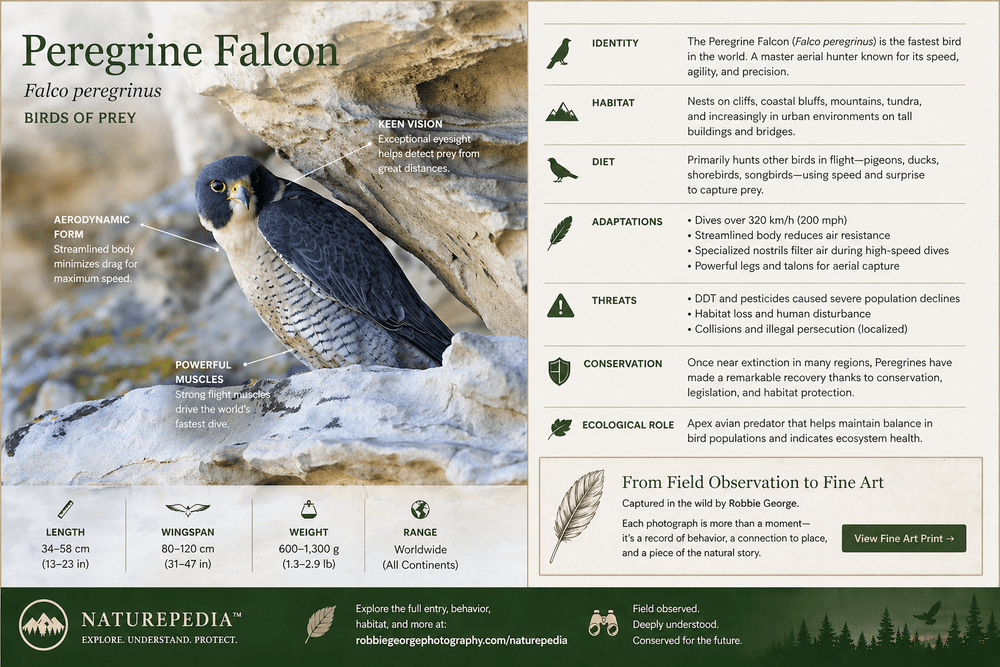
The Peregrine Falcon is a biological expression of speed. Every part of its body—from wing shape to respiratory structure—is optimized for high-velocity flight and precision hunting.
Its adaptations allow it to reach extreme diving speeds, maintain control in turbulent air, and strike prey with unmatched accuracy.
Streamlined Body
A compact, aerodynamic form reduces drag and allows efficient high-speed flight during dives.
Specialized Nostrils
Bony structures inside the nostrils regulate airflow, preventing lung damage during extreme-speed dives.
Powerful Muscles
Strong flight muscles provide acceleration, control, and the ability to recover from high-speed stoops.
Exceptional Vision
High visual acuity allows detection and tracking of moving prey from great distances and high altitudes.
Naturepedia pattern: Form → airflow, lungs → pressure control, muscles → acceleration, vision → targeting. A complete system engineered for aerial predation.
Migration & Movement: Global Range, Seasonal Shifts
Peregrine Falcons are highly mobile and widely distributed. Some populations migrate long distances between breeding and wintering grounds, while others remain resident year-round depending on climate and food availability.
Their movement patterns follow prey availability, seasonal shifts, and environmental conditions—linking coastlines, wetlands, open landscapes, and urban systems into a connected hunting range.
Breeding Areas
Cliffs, mountains, tundra, and elevated ledges provide nesting sites with strong visibility and protection.
Migration Patterns
Northern populations migrate south during winter, often following coastlines and bird migration corridors.
Year-Round Residents
In milder regions, Peregrines may remain year-round, especially in urban areas with stable prey populations.
The Peregrine Falcon represents one of the most important conservation success stories in North America. During the mid-20th century, populations declined sharply due to pesticide use—particularly DDT—which weakened eggshells and led to widespread reproductive failure.
Through bans on harmful chemicals, captive breeding programs, reintroduction efforts, and long-term monitoring, Peregrine Falcons have made a remarkable recovery and now occupy much of their historic range once again.
Primary Threats
Historic pesticide contamination, habitat disturbance, and environmental pollutants that impacted reproduction and survival.
Recovery Efforts
DDT bans, captive breeding, release programs, habitat protection, and coordinated conservation initiatives across regions.
Current Status
Now recovered in many areas, Peregrine Falcons are considered a conservation success—though continued monitoring remains important.
The Peregrine Falcon functions as an apex aerial predator, helping regulate bird populations and maintain ecological balance across open landscapes, coastlines, wetlands, and urban systems.
By hunting birds in flight, it influences prey behavior, movement patterns, and distribution—shaping the dynamics of the ecosystems it inhabits.
Predator Role
Controls populations of medium-sized birds, maintaining balance within avian communities.
Behavioral Influence
Prey species adjust movement, flocking, and habitat use in response to Peregrine presence.
System Connection
Links airspace, prey populations, migration routes, and habitat structure into a dynamic ecological system.
Naturepedia pattern: Height → speed → strike → regulation. The Peregrine Falcon compresses physics and biology into a single ecological function.
Where to Observe Peregrine Falcons
Peregrine Falcons can be observed anywhere there is height, open air, and a steady supply of bird prey. The key is to look up—toward cliffs, ridgelines, coastlines, and urban skylines where falcons use elevation as a hunting platform.
They are often seen perched on high ledges or cutting through the sky at speed. The most memorable encounters happen when a falcon commits to a dive—transforming stillness into motion in an instant.
Seabird colonies and offshore islands such as Machias Seal Island, where falcons hunt in active bird systems.
Urban Observation
Cities offer surprising opportunities—watch for falcons nesting on tall buildings, bridges, and towers where pigeons and other birds are abundant.
Field guidance: Scan high perches and open sky. Early morning and late afternoon offer the best light and activity. Patience reveals pattern—height, stillness, then sudden motion.
Naturepedia Connections
Explore how the Peregrine Falcon connects across the Naturepedia system:
Robbie George is a field photographer, naturalist, and creator of Naturepedia. Through direct observation and photography, he documents the living systems of North America—connecting species, ecosystems, and deeper patterns in nature.
His work bridges field experience with structured knowledge, creating a system where wildlife, habitat, behavior, and conservation form a connected understanding of the natural world.
NATUREPEDIA™
Explore. Understand. Protect.
Peregrine Falcon FAQ
How fast is a Peregrine Falcon?
The Peregrine Falcon is the fastest animal on Earth, capable of reaching speeds over 200 mph (320 km/h) during a hunting dive known as a stoop.
What do Peregrine Falcons eat?
They primarily eat other birds, including pigeons, shorebirds, ducks, and songbirds, which they catch in mid-air.
Where do Peregrine Falcons live?
They live in a wide range of habitats, including cliffs, coastlines, mountains, tundra, and cities where tall structures mimic natural nesting sites.
Are Peregrine Falcons endangered?
They were once endangered due to pesticide use but have made a strong recovery and are now considered a major conservation success.
The presence of this badge signifies that this business has officially registered with the Art Storefronts Organization and has an established track record of selling art.
It also means that buyers can trust that they are buying from a legitimate business. Art sellers that conduct fraudulent activity or that receive numerous complaints from buyers will have this badge revoked. If you would like to file a complaint about this seller, please do so here.
Verified Returns & Exchanges
The Art Storefronts Organization has verified that this business has provided a returns & exchanges policy for all art purchases.
Description of Policy from Merchant:
What is your Policy on Returns/Exchanges/Refunds?
I take great pride in my work and prints, and I want you to be completely happy with your investment in my nature art. If for any reason you are unsatisfied with your print, you may return it within 14 days of delivery, and/or exchange it for another print. Prints must be returned in new condition, packaged carefully in the original packaging if possible. Your refund will be issued as soon as I receive the returned print. Please contact me if you would like to arrange a return or exchange.
In the event that you receive a damaged or defective print, please let me know within 7 days of receipt, and I will arrange for a new print to be shipped to you at no additional cost.
Verified Secure Website with Safe Checkout
This website provides a secure checkout with SSL encryption.
Verified Archival Materials Used
The Art Storefronts Organization has verified that this Art Seller has published information about the archival materials used to create their products in an effort to provide transparency to buyers.
Description from Merchant:
Fine Art Prints are made with high-quality archival inks on fine art papers using a high-resolution large format inkjet printer. Our premium archival inks produce images with smooth tones and rich colors. Prints are made with care on your choice of exquisite Fine Art Papers using a high-resolution large format inkjet printer. https://www.graphikprintworks.com
Become a supporter of Robbie George Photography and be the first to receive new content and special promotions.
“Every image is a field. Every quote is a key. Welcome back to the rhythm.” ~Robbie
Cart
Your cart is currently empty.
Saved Successfully.
This is only visible to you because you are logged in and are authorized to manage this website. This message is not visible to other website visitors.
Import From Instagram
Click on any Image to continue
This Website Supports Augmented Reality to Live Preview Art
This means you can use the camera on your phone or tablet and superimpose any piece of nature art onto a wall inside of your home or business.
To use this feature, Just look for the "Live Preview AR" button when viewing any piece of nature art on this website!
Pounce Now—Save 20% on Your First Order
Join the collector list for your first-order discount, new wildlife releases, and occasional field notes.